Skip to content
CityAM
Main navigation
  • News
    • News
      • Latest Business News
      • Economics
      • Politics
      • Tech
      • Banking
      • FTSE 100 Live
      • Retail
      • Insurance
      • Legal
      • Property
      • Transport
      • Markets
    • From our partners
      • AON
      • Bayes Business School
      • Canada BIDs
      • Central London Alliance CIC
      • Destination City
      • Halkin
      • Olympia
      • Inside Saudi
      • Tottenham Hotspur Stadium
      • Santander X
      • YEAR SIX Dividend
    • Featured

      Serco hits back after Zia Yusuf accuses FTSE 250 firm of being ‘hostile to Reform’

      Former Chairman of Reform UK, Zia Yusuf addresses Reform UK supporters.

      Submit a story

      Tell us your story.

      Submit
  • Opinion
  • Sport
    • Latest Sports News
      • Sport
      • Sport Business
    • From our partners
      • The Morning Briefing: SBS x CityAM
      • Aramco Team Series
      • LIV Golf
    • Featured

      Royal Ascot worth £140m to UK economy

      Breaking news scene with journalists and cameras outside a government building, capturing a press conference in progress.

      Submit a story

      Tell us your story.

      Submit
  • Life&Style
    • Life&Style
      • Life&Style
      • Toast the City Awards
      • The Magazine
      • Travel
      • Culture
      • Motoring
      • Wellness
      • The RED BULLETiN
      • Do it with Shared Ownership
      • Media Speak Hub
    • Featured

      The best places to eat sandwiches in Lisbon, from bifanas to pregos

      Bifana do Afonsos famous bifana sandwich showcasing tender pork in a freshly baked roll with savory sauce.

      Submit a story

      Tell us your story.

      Submit
  • Investec
  • Events
  • Latest Paper
Saturday 26 July 2014 12:20 pm  |  Updated:  Friday 07 June 2019 1:41 am

Climate change increases risk of global food demand outstripping supply, study finds

By: Sarah Spickernell

Add as a preferred source on Google

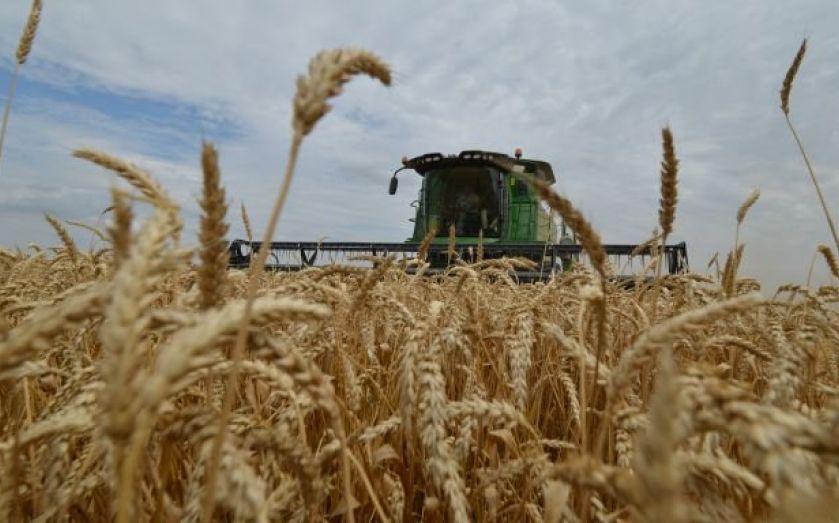
Researchers at Stanford University have found that global warming will significantly increase the risk of a major slowdown in the production of wheat and corn over the next two decades. 
 
By putting data about crops and weather into computerised climate models, they set out to estimate the chance that climate change would interfere with the ability of crop producers to keep up with demand. 
 
They used simulations to compare what would happen to the world's crop-intensive regions as a result of varying levels of carbon dioxide emissions. They also looked at what would happen in a natural environment without human-induced global warming.
 
The results of the study, published in Environmental Research letters, show that the likelihood of natural climate shifts causing a significant slowdown over the next 20 years is only 1 in 200. But when human-induced global warming is taken into account, the odds go up to 1 in 10 for corn and 1 in 20 for wheat.
 
"Climate change has substantially increased the prospect that crop production will fail to keep up with rising demand in the next 20 years," said Claudia Tebaldi, co-author of the study.
 
Global yields of crops such as corn and wheat have typically increased by about one to two per cent per year in recent decades, and the UN Food and Agriculture Organization projects that global production of major crops will increase by 13 per cent per decade from now to 2030. 
 
However, global demand for crops is also expected to rise rapidly during the next two decades because of population growth, greater per-capita food consumption, and increasing use of biofuels.
 
"We can't predict whether a major slowdown in crop growth will actually happen, and the odds are still fairly low," said Tebaldi. "But climate change has increased the odds to the point that organisations concerned with food security or global stability need to be aware of this risk."
 
The report suggests that such organisations should make plans in case a significant slowdown in crop production does occur. 
 
It also warns that although the risk could be offset by planting wheat and corn in cooler regions, such planting shifts to date have not occurred quickly enough to offset warmer temperatures. The authors also found little evidence that other adaptation strategies, such as changes in crop varieties or growing practices, would totally offset the impact of warming temperatures.Based on the findings, the study suggests that organsations affected by international food availability and price should make plans in case a significant slowdown in crop production does occur. 

Share this article

  • Facebook
  • X
  • LinkedIn
  • WhatsApp
  • Email

Similarly tagged content:

Sections

  • News

Categories

  • Business

Related Topics

  • Climate change

Trending Articles

  • London Tech Week sums up everything wrong with UK tech

  • Inflation expectations at record high in interest rates signal

  • As it happened: FTSE 100 relief rally runs out of steam as BP and Shell weigh; Oil hits three-month low

  • KPMG’s Summer Friday half-day rollback signals deeper woes for Big Four giants

  • New Gluten-Free Bread Binder Simplifies the Recipe — and Boosts Bread Quality

More from CityAM

  • The Strait of Hormuz proves fossil fuels are essential for food security

    Opinion
    View of the Strait of Hormuz, showcasing bustling maritime traffic under clear skies, highlighting its strategic significa...
  • Morningstar Shares Perspective from Global Asset Owners

    Business Wire
  • Northern Trust Asset Management Launches Sustainable Multifactor Funds

    Business Wire
  • Burberry delays climate pledge by a decade to 2050

    Retail
    Burberry fashion show runway featuring models in luxury attire showcasing the latest collection in an elegant setting
  • Data centres to consume tenth of global power by 2050

    AI
    Pylons standing tall against a clear sky following Engies acquisition of UK Power Networks, symbolizing energy sector growth.
  • Global Millennial Capital Closes USD 100 Million IPO Opportunities Fund Focused on AI, Decentralized Financial Infrastructure, and Climate Technologies

    Business Wire
  • The climate quango empire will keep growing until cheap matters more than ideology

    Opinion
    Net zero secretary Ed Miliband is set to face more pressure over high energy bills in the UK.
  • ‘Exceptionally challenging’: Starling puts climate target under review

    Fintech
    Starling is predicted to ramp up its banking-as-a-service platform in a rebrand. (Image: Starling)
  • Terms & Conditions
  • Privacy Policy
  • Cookie Policy
  • News
  • Markets & Economics
  • Politics
  • Opinion
  • Life&Style
  • Personal Finance

Follow us for breaking news and latest updates

  • Facebook
  • X
  • Instagram
  • LinkedIn
Copyright 2026 CityAM Limited