Explainer: How Russia is dodging oil sanctions and what the West is doing about it

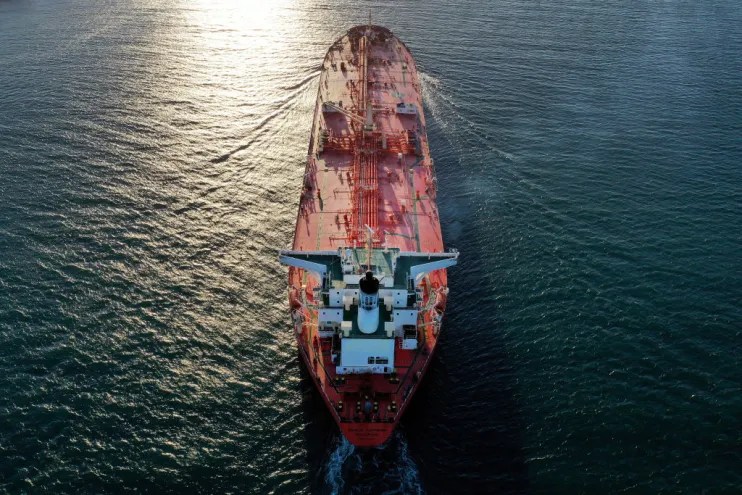
It took 282 days for the Western world to impose its first oil sanctions on Russia following its invasion of Ukraine on February 24th last year.
In this case, the sanctions are being used in an attempt to cut off the Kremlin’s petrodollars and reduce funding for its war efforts.
The primary sanctions weapon set by the G7 and its allies is a price cap preventing Western companies from procuring or transferring Russian oil for over $60 per barrel.
In the beginning, the price cap had damaging results, heavily denting Russia’s oil tax revenues. But over the course of last year, it emerged that the sanctions are proving ineffective, with Russia establishing a several-tiered ‘dark fleet’ of ships to avoid the sanctions.
Here’s an explanation of how Russia has continued to duck them and what Western governments are doing about it.
The Sanctions
The price cap remains one of the few viable options on the table for Western leaders looking to hit Russia’s ability to finance its war.
If countries had attempted to ban firms from buying Russian oil full stop, it could have triggered an extreme supply squeeze and a politically de-stabilising price rise. So the softer option of a price cap was proposed and promptly passed by G7 nations.
But under the price cap sanctions that have been implemented, ships can still move Russian oil, and insurers can still support the transfer of it, as long as the oil is sold below the $60-per-barrel cap.
Tankers are insured via Western companies known as Protection & Indemnity (P&I) clubs and cover around 90 per cent of all active cargo ship journeys in the world.
Many Western P&I firms, however, have since stopped insuring Russian tankers since the invasion. Where roughly 75 per cent of Russian tankers were using Western P&I firms last summer, that figure has now dropped to just a quarter, according to a spokesperson for leading P&I firm, NorthStandard.
Those that continue to provide insurance need to obtain ‘attestations’ from parties further down the contractual chain – the shipping company and oil firm – to state that the oil has been sold below the cap.
But the process of obtaining attestations is somewhat flawed. It is really quite easy to manufacture an attestation, which is just a piece of paper, and there is no way for shipowners and insurers to properly check if they are true or not – a problem that has allowed oil sold above the price cap to be shipped to its buyer.
Furthermore, attestations can be made for the oil being sold under the price cap, with companies then ensuring buyers pay additional sums over the reported crude costs for ‘additional fees’ like insurance and freight costs.
The ‘Dark Fleet’
As the pool of insurers started to shrink, Russia has had to rely on other methods to move its oil, notably what has been widely reported as a ‘dark fleet’ of tankers.
As ambiguous as this sounds, it helps to understand the three tiers of shipping that Russia uses.
The first are the cleared vessels which are owned and operated by Russia with the necessary paperwork, correct insurance and operating within the sanctions price cap.
The second is a ‘grey fleet’ – this is the entirely new subdivision of shipping created in response to the sanctions.
According to Maritime Insights firm Windward AI, this fleet numbers around 900 ships smuggling Russian oil that have been registered to other countries, sometimes changing to others to obfuscate ownership.
This fleet largely operates in a quasi-legal if not slippery manner, transporting oil to eager buyers including China, India and Turkey who have emerged after bans on imports from the US, UK, Canada etc.
Finally, the ‘dark fleet’, one that operates without identification systems and engages in other deceptive shipping practices while moving wet cargo, including oil, such as ID and location tampering.
Windward has identified approximately 1,100 dark fleet vessels.
Russia has been using this secret shipping operation for the majority of this year.
According to a source close to the Russian oil industry, there are likely to have been over 100 extra tankers added to the country’s ‘grey fleet, bought at a huge markup.
Commodity data firm Kpler’s lead crude analyst, Viktor Katona, told CityAM Russia’s fleet is now made up of the “pre-pensioners” – referring to ships that are most likely over 15 years old.
Unlike tankers leased to Iran in 2010 to evade sanctions, which could be called elsewhere dependent on demand, Katona explained that these tankers exclusively serve Russia’s industry.
These tankers prove tough to track. For some, companies purporting to insure or provide cargo for the vessels were quickly set up following the outbreak of the war thereby obscuring vessel origins and ownership.
Many also practice ‘flag-hopping’, the practice of changing the country flag under which the ship sails, making them extremely difficult to track via conventional shipping data monitoring.
The US Treasury Department itself made reference to the environment which Russia has built to cope with the sanctions, admitting in October that the Kremlin had spent billions of dollars to build its capabilities to run an “alternative ecosystem to sell oil without G7 involvement”.
The result? One Western official told the Financial Times last month that “almost none” of the oil Russia sold in October was done below the $60 cap.
Indeed, Russian Energy Ministry official, Vladimir Furgalsky told the Russian parliament in November that “more than 99 per cent” of Russia’s oil traded since the price cap introduction had been above the $60 per barrel ceiling.
Who’s buying?
Despite the West’s best efforts, customers for Russia’s illicit oil and ships to carry it have not been difficult to find.
India and China have emerged as two of the top importers of Russian oil this year, with the former importing a total of around $162.1bn worth of oil, which was priced between $75-130 a barrel, according to figures from state-owned Indian lender Bank of Baroda.
In 2021, Russian oil only accounted for two per cent of Indian crude imports. This year, so far, the bank contends it is around 20 per cent.
The Centre for Research on Energy and Clean Air (CREA) said that for November, India’s total crude oil imports reached 17.7 mn tonnes, 31 per cent of India’s total crude oil imports in November came from Russia — the largest share from a single country.
West ramps up sanctions
But the growing body of evidence the price cap wasn’t working as intended, and that Russia is doing all it can to get around it, forced the West to take action.
Indeed in October, November and December, the US Treasury Department’s sanctions office, known as OFAC, sanctioned several ships for carrying Russian crude above the price cap.
The December sanctions covered three ships: the NS Champion, owned by UAE-based Sterling Shipping, the Viktor Bakaev owned by UAE-based Streymoy and the HS Atlantica, owned by Liberia-headquartered HS Atlantica.
All of them, OFAC said, were found to be carrying Russian crude oil above $70/b.
According to S&P Global Maritime Intelligence Risk Suite, the NS Champion and Viktor Bakaev are ultimately controlled by Russia’s state-owned tanker operator Sovcomflot, which is itself on the sanctions list. These tankers are the fifth and sixth Sovcomflot tankers to be placed on the sanctions list by OFAC.
As scrutiny on the Russian oil price cap has tightened, three of Greece’s largest shippers – Minerva Marine, Thenamaris and TMS Tankers – stopped transporting Russian oil before the beginning of December.
And for the first time, the sanctions were beginning to move the dial.
India’s Russian oil imports fell to 1.48m barrels per day, an 11-month low, in December, according to Kpler data – largely because sanctions prevented five tankers carrying around five million barrels of Russian oil from docking in India.
According to Equasis data, these were the Liberia-flagged Krmysk, Nellis, NS Century, NS Commander and the Panama-flagged Sakhalin Island.
And, despite India’s leaping from almost zero to around 40-45 per cent of Russian seabourne crude exports within two years, China remains the biggest customer of Russia’s primary seabourne crude oil industry, totalling around 50 per cent.
So, what’s next?
At the end of December, the G7 released plans to “tighten” the price cap restrictions by requiring shipping providers to receive written attestations from their buyers each time Russian oil is loaded.
This, the coalition said, would reduce the risk of “ancillary costs,” such as insurance and freight, with entities “further down the supply chain,” being tagged on.
The G7 estimates estimated that tax revenue from oil and petroleum product exports – Russia’s key source of revenue – was 32 per cent lower between January and November 2023 against the corresponding 2022 period.
In this respect, it believes the price cap on crude oil has been “successful in advancing both of our goals of supporting stability in energy markets while reducing Russian revenues that it could otherwise use to fund its illegal war.”
But Russia had a final flourish to close out 2023.
According to Bloomberg data, seaborne crude exports ended the year on a high, as four-week average shipments climbed to 3.46m barrels a day in December, the highest since early November and weekly flows jumped to the most since July.
Many were perhaps expecting more teeth in the latest sanctions round as Russia proves highly adept at avoiding the whack-a-mole strategy of individual ship sanctioning from the US and catch-up measures pertaining to attestation requirements.
But it appears that for now, that remains the strategy.
Like the mythological hydra, for every head the West removes, Russia grows two more in this very obscure form of attritional war of logistics.