Fifa crisis: Is it possible to defend Infantino’s World Cup sell-off plan?

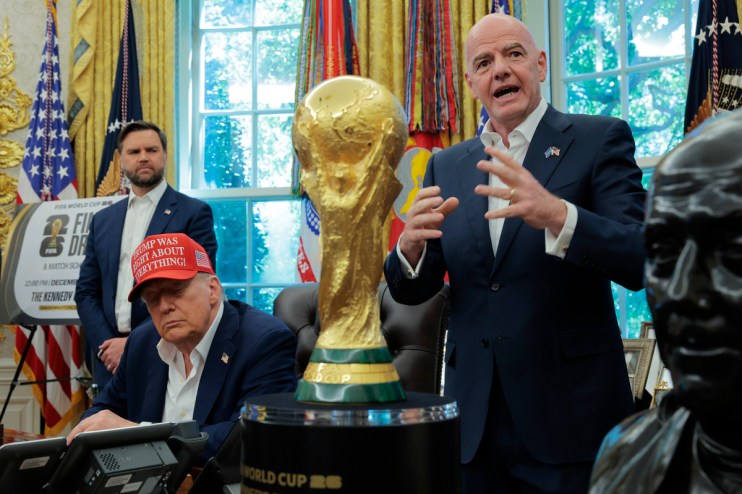
Crafting a defence of Infantino isn’t easy, but it is possible to assemble both a behavioural excuse and a commercial justification for the Fifa president’s plan to sell stakes in the World Cup.
One newspaper evocatively likened Gianni Infantino to Icarus at the weekend after his proposal to sell stakes in the World Cup melted in the face of global condemnation. I prefer to think of Fifa’s president as akin to Zaphod Beeblebrox. The egotistical star of The Hitchhiker’s Guide to the Galaxy was, after all, the only being to emerge alive from the Total Perspective Vortex.
Rather than Beeblebrox’s two brains being annihilated by the Vortex’s revelation of his true insignificance when juxtaposed against the “infinity of creation”, the two-headed President of the Galaxy stepped out of it, asked for a drink and declared: “It just told me what I knew all the time. I’m a really terrific and great guy. Didn’t I tell you, baby. I’m Zaphod Beeblebrox!”
Douglas Adams’s fictional creator of the Vortex, Trin Tragula, intended to demonstrate that to survive in the universe you can’t afford to have a sense of proportion, else you would be crushed. Infantino, though, might right now be wishing that his detractors could rediscover proportionality.
Crafting any defence of Infantino isn’t easy, nor does anyone appear willing to make one publicly just yet, but it is possible to assemble both a behavioural excuse and a commercial justification.
The behavioural excuse for Infantino
Neither, if first worked up and then sold hard by the Fifa president’s acolytes, would be guaranteed to save his position – but don’t be surprised to see him in post for some considerable time to come. And do expect the suggestion of external investment into Fifa competitions to recur.
The road to power in any of sport’s international ruling bodies is a long, arduous and often dirty one. Election processes typically involve the cultivation of relationships across the world over many years. Lots of the meetings involved will feel grubby.
A sport’s competition and governance calendars bring electorate and candidates together at world and area championships as well as for congresses and conferences. These set-piece events enable contact grids to be coloured in and possible votes tallied.
The hardest air miles, though, are those flown between times for one-to-one conflabs at which promises of largesse can be made and promises of votes extracted in return.
Inevitably, more of the former are spoken than could ever be fulfilled, and more of the latter are banked than will actually be cast in secret ballots. Many presidential candidates have been dismayed to receive just a fraction of the votes in an election that they thought they had secured beforehand on the road.
Once in office, however, sport’s leaders enjoy the triple benefits of highly secure tenure, a five-star working lifestyle, and widespread fawning from sycophantic member nations, board and council colleagues, staff, commercial partners and wannabe host city representatives. Incumbent presidents are rarely seriously challenged when the time comes for re-election, safe in the knowledge that to oppose is to risk having you and your country thrown off the gravy train.
These forces are as true of smaller sports as the largest, although the financial rewards and quality of hotel rooms and chauffeured limos may differ at either end of the spectrum. For football and the Olympics in particular, though, every factor is dialled up to the max.
The numbers are so big, there is so much money to go around, the stakes are so huge in pitching for hosting, broadcast or sponsorship rights, that the power of the presidency really must feel like that of a political ruler – at least of a medium sized nation today, or perhaps of a medieval monarch.
Imagine not merely finding yourself in such a position, but also having undertaken the hard yakka over many years to get yourself there. Could you then avoid its pitfalls, inure yourself to the suck-ups, survive rubbing shoulders with the leaders of the free and not-so-free worlds, stay true to your original principles? We all like to think we would, I’m sure. But in reality…?
The behavioural excuse for Infantino, then? He’s only human, even if he’s apparently lost his sense of proportion.
The commercial justification for Fifa
The headlines accompanying the Fifa president’s plan for outside stakes in a new competition vehicle have screamed that he was selling the World Cup (“heresy!”). Throw in promised funds for member nations (“bribes!”), a short deadline to sign up (“threats!”), the involvement of Josh Kushner (“Trump!”), the suggestion of his own huge reward (“greed!”) and the media winkling out the story (“secrecy!”), and there is lots to be suspicious of and to deride. But is the underlying principle so fanciful?
The trend across the sport’s industry in recent years has been to bring in outside money to event hosting, both to get new ventures off the ground and to enhance existing competitions. For some sporting bodies, this is effectively venture capital to pursue new opportunities that would otherwise never get off the drawing board for lack of funding. For others, it might be to facilitate higher quality event presentation and more extensive marketing, or perhaps to break into new territories.
It is possible that Fifa is in pursuit of a combination of all of the above across its various tournaments and that, despite all of its balance sheet riches, new money would drive fresh and bolder thinking, and bring a different and possibly more productive risk appetite than can ever exist within a governing bureaucracy of such scale.
None of which means that Infantino and colleagues have gone about this pursuit of public/private hybrid enterprise in the right way. The core concept is on trend, though.
The commercial justification for Infantino, then? Right idea, but wrong in so much of its intended execution.
The Fifa president may be gone in days, weeks or short months. He is more likely, I’d say, to get in front of the broad swathe of his membership who are not part of Uefa and make the case that he is at worst guilty of over-ambition for their sport. This is the time when those years spent building relationships pay their loyalty dividends.
Europe has been football’s breadbasket for over a century, but the balance of financial power has been inexorably tilting away from it. While choosing in high dudgeon to try to oust Infantino now, Uefa’s members may find in due course that the rest of the world is in a more forgiving mood and the power balance tilts still further away from them.
Right now, if Fifa’s dissenting members want to maximise their chances of defeating Infantino, they need to identify a single unity candidate they can all rally behind. The deadline for that is mid-November, ahead of the scheduled election in March next year.
Identify that candidate swiftly and the odds of them successfully engineering an emergency, early process would be significantly enhanced.
Ed Warner is chair of Sussex Cricket and GB Wheelchair Rugby and writes his sport column at sportinc.substack.com