Inside Paul Pogba’s Saudi camel racing club Al Haboob

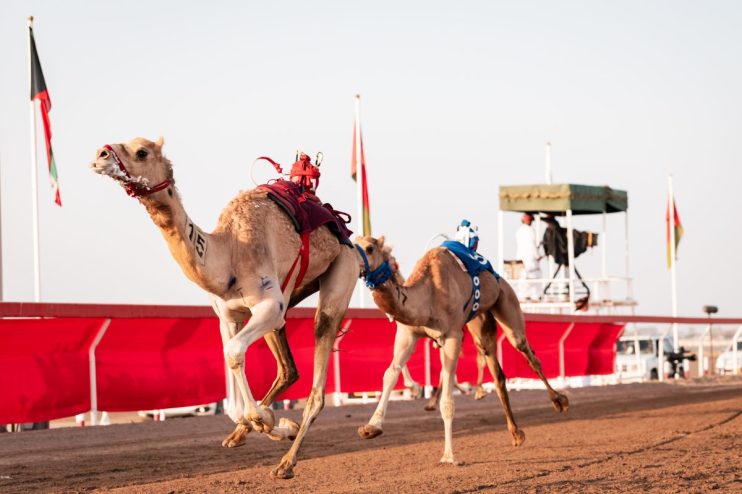
Last year Paul Pogba invested into the Al Haboob camel racing club in Saudi Arabia. Matt Hardy goes behind the scenes with its founders.
Over 1,000 years ago the warring tribes of the Arabian Peninsula, eager to stake their claim to the region’s limited land with access to its surrounding seas and gulfs, used to settle disputes not with a jousting competition or the 7th century version of pistols at dawn. Instead they raced camels – the backbone of a transportation industry in the barren landscape of what is now modern-day Saudi Arabia – with the winner earning its owners the coveted beachhead, important for trade and survival.
Today camel racing is a strictly sporting pursuit dominated by the Royal families and aristocrats of the Gulf Cooperation Council region – spanning Bahrain, Kuwait, Oman, Qatar, Saudi Arabia, and the United Arab Emirates – with meets spanning weeks, featuring races with upwards of 85 entries and prize money into the tens of millions of Riyals – around £4m, similar to Ascot’s Champions Day. Last year it got a new entrant, the Al Haboob team, which is seeking to show the sport is also a viable business. It is the brainchild of two Saudi men, Omar Almaeena and Safwan Modir, and a surprise investor: footballer Paul Pogba.
The former Manchester United midfielder, now at Monaco, holds a minority stake in Al Haboob – described as a “decent” wedge by his camel-owning peers – and has claimed he wants to hold a stable featuring a $5m star.
“Paul’s involvement is about the crossover between sport and global icons,” Almaeena tells CityAM. “He’s not just there as an ambassador and for marketing, he is invested in the team as a shareholder and understands the value of what this means. He’s into how we grow this and use his platform.”
Camel racing kings
The sport itself has evolved from its tribal roots. It can cost as little as £40,000 to buy a competitive camel, with money to be made by impressing the royal stables at meets in the likes of Saudi Arabia and Qatar. Almaeena and Modir explain that often aristocrats – recently the Qataris – have been known to buy up the top 10 placed camels in the bigger races, partly to add to their stables but to weaken rivals too. For existing owners it is a double pay-day, often close to £1m, if they’re able to claim the £500,000 for winning the showpiece race and similar for flogging their camel to the highest bidder.
Adds Modir: “We are going to be inspiring more people to go into this industry with the same business model we are doing.” Their model is one of franchise growth – the pair are stars of a hit Gulf Netflix show, Camel Quest – and looking to challenge the established racers with thousands of years of humped bloodlines in their back pockets. Of Pogba’s appeal, Modir said: “You now have an entire football fan base that has been exposed to camel racing.”
The Al Haboob pair state that the likes of oil giant Shell and national Gulf banks are now sponsoring races, in part thanks to Pogba raising camel racing’s profile. The Gulf’s decision to swap child jockeys – the US Department of State said in 2005 that children as young as two were trafficked from Asia and exploited for rising use – for robot alternatives in the early 2000s has modernised the sport’s reputation, while a preference to follow the camels in cars rather than watch from hospitality stands is described as key to keeping the sport traditional.



At Royal Ascot?
Almaeena and Modir – with Pogba in tow – have big plans, and they involve looking westward. Asked whether they’d want to have a camel race at Royal Ascot, Almaeena says “definitely” but admits European attitudes to camels more widely and the diseases they have been known to carry are a major obstacle. The EU is against the animal’s importation.
“There is a possibility that within the next 14 months we will have a race somewhere in Europe,” Almaeena claims. That race could come with a second major sporting investor buying into Al Haboob and the franchise system. “Hopefully we attract Shaquille O’Neal to invest,” Modir says with intent. “That’s a wish that we have: Shaq on the track.”
Relatively niche sports are having their moment; SailGP, fencing, padel and equestrian, to name a few. Camel racing remains one of the most popular pastimes in the Gulf, despite the region looking to westernise its offering beyond its shorelines.
Maybe it is for that reason that the sport remains a love for the region’s royals – like the Ascot Gold Cup was to the late Queen. Its inherent display of domestic wealth and power is its strongest asset; breaking out of the Middle East and into Europe is another ball game. And that’s where having Pogba to lead the line could become the sport’s biggest transfer.