Skip to content
CityAM
Main navigation
  • News
    • News
      • Latest Business News
      • Economics
      • Politics
      • Tech
      • Banking
      • FTSE 100 Live
      • Retail
      • Insurance
      • Legal
      • Property
      • Transport
      • Markets
    • From our partners
      • AON
      • Bayes Business School
      • Canada BIDs
      • Central London Alliance CIC
      • Destination City
      • Halkin
      • Olympia
      • Inside Saudi
      • Tottenham Hotspur Stadium
      • Santander X
      • YEAR SIX Dividend
    • Featured

      UK manufacturers facing ‘steel quota cliff edge’

      The steel industry has been particularly badly hit by rising energy costs

      Submit a story

      Tell us your story.

      Submit
  • Opinion
  • Sport
    • Latest Sports News
      • Sport
      • Sport Business
    • From our partners
      • The Morning Briefing: SBS x CityAM
      • Aramco Team Series
      • LIV Golf
    • Featured

      2026 World Cup: England only attract half as many bets as Norway to lift trophy

      Breaking news concept with digital globe and financial charts, signifying global economy and stock market trends.

      Submit a story

      Tell us your story.

      Submit
  • Life&Style
    • Life&Style
      • Life&Style
      • Toast the City Awards
      • The Magazine
      • Travel
      • Culture
      • Motoring
      • Wellness
      • The RED BULLETiN
      • Do it with Shared Ownership
      • Media Speak Hub
    • Featured

      Old Pulteney releases 50-year-old whisky for 200th anniversary

      Old Pulteney 50-Year-Old single malt Scotch whisky bottle with elegant packaging on display, highlighting luxury and craft...

      Submit a story

      Tell us your story.

      Submit
  • Investec
  • Events
  • Latest Paper
Tuesday 27 August 2024 6:30 am  |  Updated:  Tuesday 27 August 2024 9:31 am

Interest rates are coming down – but how low will they go?

By: Chris Dorrell

Add as a preferred source on Google
The Governor's comments were seen as slightly more dovish than his previous guidance had implied, prompting markets to anticipate further rate cuts in the months ahead.
Andrew Bailey could make the final call on interest rates in December.

Central bankers could be forgiven for feeling a sense of triumph at last week’s annual Jackson Hole jamboree.

In most advanced economies, inflation has returned to the two per cent target without squashing economic growth. A couple of years ago, when inflation was in the double digits, this would have seemed nothing short of miraculous.

Although economic conditions differ substantially on either side of the Atlantic, central banks are now about to embark on a (relatively) coordinated cutting cycle at or near full employment.

There will be multiple debates over the next few months about how fast and how far interest rates should be cut, but lurking behind many of these debates will be the blurry concept of R*, or the neutral rate of interest.

R* is the interest rate at which an economy operates at full capacity with a steady rate of inflation. It is the Goldilocks interest rate.

There’s just one problem. R* is impossible to measure. Like mystics deciphering the designs of an ineffable God, central bankers can only judge R* through its impact on the economy.

Perhaps unsurprisingly, most rate-setters stay well clear of making any (public) judgement about where the neutral rate might be.

Having said that, R* still guides actions. Despite the handful of rate cuts we have seen, monetary policy remains comfortably in ‘restrictive’ territory. Changes to R* will therefore also change how restrictive or loose monetary policy really is.

So where is R*?

As the UK is a relatively small, open economy, R* will mainly be determined by changes to the global economy.

The most important factor that determines R* is the balance of savings and investment. It is widely argued that R* – both in the UK and around the world – has been on a steady downward trend since the 1970s.
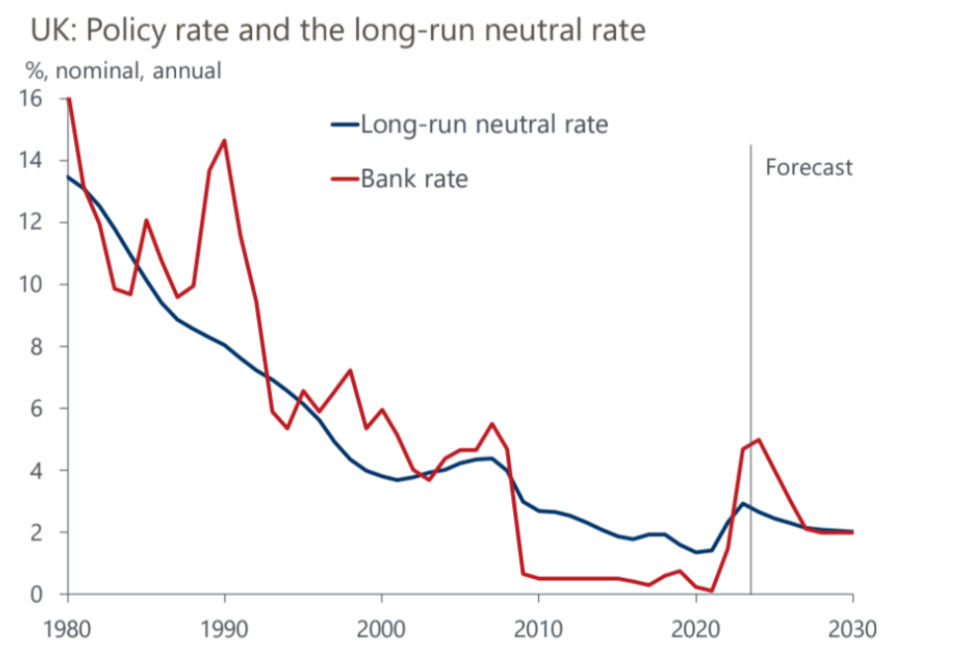
Source: Oxford Economics and Haver Analytics

There are two main forces at play here. First, as life expectancy has increased, people have set aside more and more money to enjoy during their retirement. This has pushed up the supply of savings.

Read more

Bank of England’s Bailey: Interest rates hike may not be needed

Andrew Bailey, Governor of the Bank of England, used his speech to stress the importance of effective regulation. Credit: Henry Nicholls/PA Wire

Secondly, there has been a prolonged slowdown in productivity growth, which has lowered the return on capital, and thus the demand for investment.

With the supply of savings higher and demand lower, it is no surprise that the price – the interest rate – has fallen. Taking into account the impact of inflation, most economists put the neutral rate at or near zero pre-pandemic.

Since the pandemic, however, most estimates suggest that R* has increased. At first glance, this seems a little odd. After all, why would the pandemic have sent these long-term trends into reverse? Populations are still ageing and productivity growth is still slow.

Part of the answer is due to inflation expectations. Before the pandemic, investors had largely forgotten that inflation existed. Turns out it does. As such, investors now expect a slightly higher return from longer term assets to act as a hedge against the risk of inflation.

It’s not clear if this will be a permanent shift or not, but there are a couple of longer term factors that help explain why R* might be rising.

Given the range of challenges facing advanced economies at the moment, from the green transition to increasing geopolitical tensions, there is likely to be a need for more investment in the years ahead.

According to McKinsey, achieving net-zero by 2050 would require average annual investment to be $3.5 trillion higher than it currently is. That is a very big number which will no doubt impact the neutral rate.

In a speech earlier this year, Isabel Schnabel, a rate-setter at the European Central Bank, said that the “exceptional investment needs… may have a persistent positive impact” on R*.

There’s also the hope that artificial intelligence (AI) might address the long-term slowdown in productivity growth, which would make investment more attractive too. Economists at Goldman Sachs think productivity gains related to AI could help lift global GDP by seven per cent.

In other words, there are some compelling reasons to think the neutral rate has crept up and will continue to do so.

These factors will not be front of mind for rate-setters over the next few months, but they will be hugely important for determining the longer term path of interest rates.

Read more

Bank of England should hold interest rates, CityAM Shadow MPC says

Bailey Boe in professional attire speaking at a business conference with a presentation screen in the background.

Share this article

  • Facebook
  • X
  • LinkedIn
  • WhatsApp
  • Email

Similarly tagged content:

Sections

  • News

Categories

  • Economics

People & Organisations

  • Andrew Bailey
  • Bank of England
  • Christine Lagarde
  • ECB
  • Fed
  • Jackson Hole
  • Jerome Powell

Trending Articles

  • Berg Finance 2021 DAC Expected to be Repaid on the July Payment Date

  • UK manufacturers facing ‘steel quota cliff edge’

  • Suralink Launches Cloud Testing Suite to Bring Agentic Execution to Audit Engagements

  • Lattice to Showcase Industry-Leading FPGA Innovations at FPGA Conference Europe 2026

  • CRH elects W. Anthony (Tony) Will to its Board of Directors

More from CityAM

  • Bank of England’s Bailey: Interest rates hike may not be needed

    Economics
    Andrew Bailey, Governor of the Bank of England, used his speech to stress the importance of effective regulation. Credit: Henry Nicholls/PA Wire
  • Bank of England should hold interest rates, CityAM Shadow MPC says

    Economics
    Bailey Boe in professional attire speaking at a business conference with a presentation screen in the background.
  • Borrowing costs fall as interest rate hike fears ease

    Economics
    Keanu Reeves seen casually dressed during a public appearance in a local pub, engaging with fans and enjoying a relaxed at...
  • Inflation expectations at record high in interest rates signal

    Economics
    Bank of England building on Threadneedle Street, London, showcasing its historic architecture and financial significance
  • Jeevun Sandher MP: I am committed to Labour’s fiscal rules, but delivery matters too

    Opinion
    Labour Party celebrates new leaders election with cheering supporters and waving flags at campaign headquarters
  • Interest rates set to be held as inflation to remain ‘elevated’ despite Iran peace deal

    Economics
    For the first time in months, economists are unsure whether the Bank of England will cut interest rates.
  • It’s not the Bank of England’s job to support the Chancellor

    Opinion
    Andrew Bailey, Bank of England governor, discusses economic policy during a press conference at the central bank headquart...
  • ECB inflation survey points to sharp surge in prices

    Economics
    Annual inflation fell to 1.8 per cent in September, down from 2.2 per cent in August and below the 1.9 per cent expected by economists.

CityAM Canada — business, markets and opinion for Canadian readers.

Sections

  • Business
  • Markets
  • Tech
  • AI
  • Economics
  • Opinion
  • Cities

Company

  • About
  • Contact

Legal

  • Terms of Use
  • Privacy Policy
  • Cookie Policy
© 2026 CityAM Canada. All rights reserved.
Terms · Privacy · Cookies