Skip to content
CityAM
Main navigation
  • News
    • News
      • Latest Business News
      • Economics
      • Politics
      • Tech
      • Banking
      • FTSE 100 Live
      • Retail
      • Insurance
      • Legal
      • Property
      • Transport
      • Markets
    • From our partners
      • AON
      • Bayes Business School
      • Canada BIDs
      • Central London Alliance CIC
      • Destination City
      • Halkin
      • Olympia
      • Inside Saudi
      • Tottenham Hotspur Stadium
      • Santander X
      • YEAR SIX Dividend
    • Featured

      My ride in a helicopter over London as Leonardo expands its UK presence

      Helicopter flying over urban landscape during daylight, showcasing cityscape and modern infrastructure for news report.

      Submit a story

      Tell us your story.

      Submit
  • Opinion
  • Sport
    • Latest Sports News
      • Sport
      • Sport Business
    • From our partners
      • The Morning Briefing: SBS x CityAM
      • Aramco Team Series
      • LIV Golf
    • Featured

      2026 World Cup: England only attract half as many bets as Norway to lift trophy

      Breaking news concept with digital globe and financial charts, signifying global economy and stock market trends.

      Submit a story

      Tell us your story.

      Submit
  • Life&Style
    • Life&Style
      • Life&Style
      • Toast the City Awards
      • The Magazine
      • Travel
      • Culture
      • Motoring
      • Wellness
      • The RED BULLETiN
      • Do it with Shared Ownership
      • Media Speak Hub
    • Featured

      Old Pulteney releases 50-year-old whisky for 200th anniversary

      Old Pulteney 50-Year-Old single malt Scotch whisky bottle with elegant packaging on display, highlighting luxury and craft...

      Submit a story

      Tell us your story.

      Submit
  • Investec
  • Events
  • Latest Paper
Wednesday 18 September 2013 4:33 am

Productivity is 16 percentage points below G7 average – the widest gap since 1993

By: Harriet Green

Add as a preferred source on Google

Compared with the other major industrialised economies, UK output per hour was 16 percentage points below average in 2012.

Output per worker basis came in at 19 percentage points lower than the average for the rest of G7 for 2012, according to latest figures from the Office of National Statistics (ONS).

Both output per hour and per worker fell in 2012 compared with 2011 in the UK. Across the G7, these measures both increased from 2011 to 2012. 
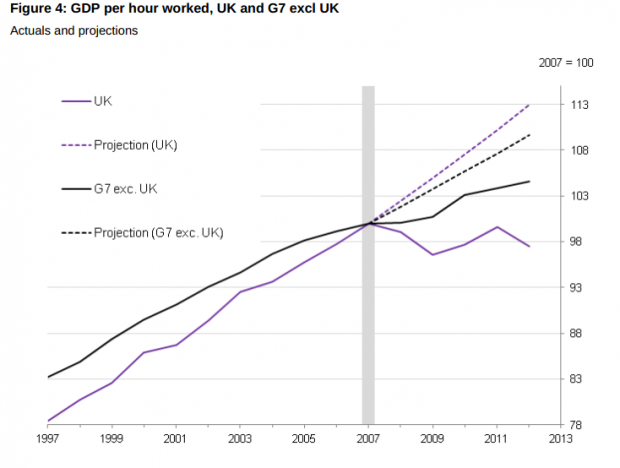
(Office for National Statistics)

Howard Archer, chief UK and european economist at IHS Global Insight, comments on the productivity data:

The extent to which the weakness in the UK’s productivity has been structural rather than cyclical has vital implications for the economy’s growth potential and for policy. Particularly relevant at the moment, the Bank of England is assuming that productivity will pick up appreciably as UK recovers with the result that the unemployment rate will come down gradually. This is a key factor in the Bank of England’s view that the unemployment rate will not come down to 7.0% before mid-2016 with the result that it is unlikely to raise interest rates before then.

If much of the weakness of productivity is cyclical, then it clearly should improve markedly as the economy recovers.

An element of the UK’s poor productivity performance does appear to have been companies’ willingness to hold on to workers, particularly when the workers are skilled or experienced. There have also been reports that some companies employed more people, or at least retained workers, as they found winning and delivering work more resource intensive in an environment of persistently weak demand. For example, extended weak housing market activity clearly hit the productivity of estate agents as it is took them longer to sell a house.

There are other factors that could have hurt productivity on a more lasting basis. There is concern about the impact of “zombie” companies that are essentially being kept alive by low interest rates and banks’ reluctance to write off loans. Not only are these companies generally unproductive, but there is concern that they are preventing credit and resources being reallocated to newer companies and backing new products and processes.

There is particular concern that an extended inability to access capital has held back innovation and investment by smaller companies.

A marked overall decline in business investment during 2009-2012 may have significantly damaged UK productivity as a number of companies failed to invest to upgrade dated capacity or adapt latest technology and production techniques. 

From the ONS: 

Average productivity growth between 1997 and 2007 for the rest of the G7 was lower than in the UK (around 1.9%, compared with 2.5% for the UK), and productivity performance since 2007 has on average been somewhat stronger, implying a smaller productivity gap of around 5 percentage points on the same basis.

(Office for National Statistics)
 

From the ONS:

GDP per hour worked
UK productivity in 2012 was:
• Marginally below that of Canada and Italy
• Below that of Germany and France by 24 percentage points
• Below that of the US by 29 percentage points
However, Japanese GDP per hour worked was 16 percentage points below that of the UK.
 
(Office for National Statistics)
From the ONS: 
GDP per worker
First estimates for 2012 show UK output per worker:
• Below that of Canada and Germany by 5 percentage points
• Below that of Italy and France by 10-11 percentage points
• Below that of the US by 40 percentage points
However, Japanese GDP per worker was 11 percentage points below that of the UK.
 
There are considerable differences in average hours worked across the G7, although the general long term trend is towards lower average hours. Differences between countries reflect cultural, legislative and compositional differences, for example between shares of full-time and part-time employment. Average hours in the UK are around the average of the G7, and have fallen less than in Japan, Germany and France. The difference in average hours in 2012 between the US (where average hours are highest among the G7) and Germany (lowest) is equivalent to a difference of around eight hours per week. (ONS)
 

Share this article

  • Facebook
  • X
  • LinkedIn
  • WhatsApp
  • Email

Similarly tagged content:

Sections

  • News

Categories

  • CityAM Content

Trending Articles

  • As it happened: FTSE 100 relief rally runs out of steam as BP and Shell weigh; Oil hits three-month low

  • Rathbones to suspend thousands of client account inflows after FCA probe deals £530m blow

  • Rolls-Royce shares surge as SMR unit bags multi-billion pound Swedish nuclear contract

  • More Big Four blues as Deloitte plans to slash UK audit roles

  • London Tech Week sums up everything wrong with UK tech

More from CityAM

  • Financial services contributed a tenth of UK economic output in 2025 

    Economics
    Skyline of Canada financial district with modern skyscrapers and historic landmarks under a clear blue sky
  • A state of the nation tale: The National Rail Museum won’t accept a model railway set

    Opinion
    Detailed model railway set showcasing intricate train tracks and miniature landscapes for hobby enthusiasts.
  • UK firms are spending billions on AI – but getting extra admin in return

    Tech
    The AI startup was founded in 2023 by seasoned entrepreneurs Yann Sarfati and Tristan Saunders, both with experience in the tech industry.
  • Britain’s £800bn investment pile that isn’t being used

    Opinion
    Traders analyzing data on screens at London Stock Exchange, showcasing investment trends and market activity
  • Andy Briggs: UK is hurtling towards a pensions disaster

    Opinion
    Young people face the risk of failing to save enough in their pension
  • Rachel Reeves oversees borrowing spike as benefits spending offsets tax haul

    Economics
    Breaking news event with attendees discussing the latest developments and impacts in the general news sector
  • World Cup won’t boost US or European economies, experts warn

    Sport Business
    Breaking news event with diverse crowd in urban setting, capturing dynamic interaction and vibrant city atmosphere
  • Two-tier taxes are not the way to get Britain back to work

    Opinion
    Robert Jenrick speaking at a press conference, addressing current policy issues, wearing a suit and standing behind a podium

CityAM Canada — business, markets and opinion for Canadian readers.

Sections

  • Business
  • Markets
  • Tech
  • AI
  • Economics
  • Opinion
  • Cities

Company

  • About
  • Contact

Legal

  • Terms of Use
  • Privacy Policy
  • Cookie Policy
© 2026 CityAM Canada. All rights reserved.
Terms · Privacy · Cookies