‘Shenanigans’: Did the OBR save Reeves from hiking income taxes at the Budget?

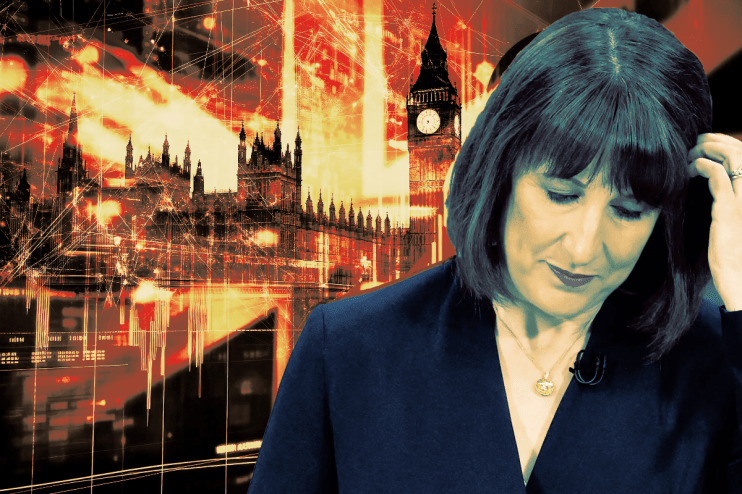
For weeks, Chancellor Rachel Reeves had been engaged in an extraordinary communications exercise of expectation management, leading Brits to believe that income tax was about to hiked for the first time in 50 years.
In an unusual press conference earlier this month, she told journalists that everyone would have to contribute to the Labour government’s extra spending on defence and the NHS.
Bond traders responded positively to speculation that a headroom-fixing tax rise was coming, with gilt yields falling gradually over the last month as tax speculation grew. A 2p increase in income tax, coupled with a 2p decrease to national insurance for lower earners, would have raised up to £7bn, according to some economists’ estimates.
The government’s lenders support moves to raise income taxes given it is the largest – and most reliable – revenue-raiser for the government while potentially having a lower impact on growth than a messy range of other tax hikes.
Bond traders see a reliable method of raising income as being less likely to lead to sudden and unforeseen jumps in borrowing and uncontrolled spending. Two thirds of voters, meanwhile, would want to see Reeves go if the key Labour manifesto promise was broken, according to CityAM polling.
‘Ideology, stupidity and incompetence’
Once those income tax hike plans were binned, investors lost faith in the government’s economic plans. Gilt yields went up by as much as 14 basis points, adding hundreds of millions of pounds to projected government borrowing costs.
A new line was then swiftly shared with Bloomberg: the OBR had upgraded its forecasts across forecasting rounds and stripped £10bn off the estimated £30bn fiscal hole.
On Monday afternoon, shadow chancellor Mel Stride attacked the government for showing “utter contempt” to parliamentarians blindsided by leaks while Speaker of the House Lindsay Hoyle also reprimanded Labour for “hokey pokey” briefings. James Murray, the chief secretary to the Treasury, said pre-Budget noise and speculation was “regrettably” predictable but refused to say whether an inquiry would be launched.
Like Stride, the chaotic U-turn in tax policymaking has infuriated the City.
In response to the briefings and amid falling consumer confidence levels, Shore Capital’s research analysts didn’t mince their words: “It is with great disappointment and frustration, from a UK consumer economy perspective, that we approach the Budget of 2025 with such disdain for the top leadership of the country, and to be clear many senior officials, where, to ideology, naivety, and stupidity, we can add total incompetence.”
There are now some suspicions over the credibility of briefings offered to the media..
Was Reeves saved by a ‘magic wand’?
Julian Jessop, an independent economist who formerly worked at the top consultancy Capital Economics, told CityAM that Labour’s justifications for ditching income tax hike plans “don’t add up”.
In the eight weeks before a Budget, the OBR and the Treasury enter in a six-round ping pong match of number-crunching. The OBR hands the Treasury a printed spreadsheet of economic forecasts, measuring how far Reeves and the Treasury will miss her fiscal rules by.
At the end of the third round, the Treasury will have shared their main fiscal proposals with the fiscal watchdog, which adjusts forecasting figures on a round-to-round basis.
Jessop suggested that the briefings by those working under Reeves didn’t stack up because of their timing as he believes the OBR would have likely taken any “favourable” changes in the UK economy into account by the end of the first three rounds.
Those will have included a fall in gilt yields over the 10 days to October 21, squeezing the fiscal hole by an estimated £1.7bn compared to previous government borrowing cost estimates.
“Unless something very unusual has happened, the OBR would have included all the more favourable economic assumptions in the forecast round that ended on the 31st of October,” Jessop told CityAM.
“If the forecasts were really so much better, why is she now scrambling around for alternative ways to fill the hole? The whole thing doesn’t smell right to me.”
“It is possible they have done things completely differently to what they have done in the past. But I see no evidence that they have.”
Previous OBR-Budget rounds have led to some unexpected victories for beleaguered Chancellors. Before the 2023 Autumn Budget, former Chancellor Jeremy Hunt said no tax cuts would be affordable, only to slash national insurance from 12 per cent to 10 per cent.
But as the Centre for Policy Studies (CPS) chief, Robert Colville, pointed out in his newspaper column, it was “vanishingly rare” that the OBR would make a £10bn adjustment “this late and this fast”.
There is still the slim possibility that the OBR took notice of some more positive forecasts and re-interpreted data sets it had been handed.
Pantheon Macroeconomics analysts argued that the OBR risked being too downbeat about its 0.3 percentage point downgrade to productivity trend forecasts, costing the government £20bn alone. Economists at the consultancy said unreliable figures published in the Office for National Statistics (ONS) misfiring Labour Force Survey told a sadder story about the UK economy than what was actually happening.
The official data body, for one, said last week that productivity growth was 1.1 per cent, above the OBR’s current forecasts, though data can be volatile and revised several months or years later.
OBR’s ping-pong match with the Treasury
Since the Budget forecasting process began, researchers at the Resolution Foundation – the left-leaning think tank which was once led by Budget brains Torsten Bell and the workplace of OBR chief Richard Hughes – said the OBR should not place too much weight on data recorded around the 2008 financial crisis. The institution estimated the fiscal hole to be £14bn, partly as a result of higher wage growth projections in the medium term than set in March.
Resolution Foundation economist Elliott Christensen said he would be “surprised” if wage growth calculations were not made in earlier OBR forecast rounds.
Excitable wonks will ultimately be reading between the lines on what the OBR writes in the foreword to its report. A widely-missed nugget from its forecast report at the Spring Statement was a comment suggesting the Treasury panicked at the last minute over Reeves’ proposed welfare spending cuts, leaving the OBR with “insufficient information” for disability payment reforms to be scored. The sniping comments lifted the veil on the viciousness of negotiations in Whitehall between officials with PhDs and career politicians.
But the endless debates have left the UK’s economic veterans with headaches.
With £10bn headroom representing a slither of government expenditure amounting to more than £1.2 trillion and total UK expenditure twice that size, the former head of the National Institute of Economic and Social Research (NIESR) Jagjit Chadha criticised the “facile” obsession with small number changes affecting public finances.
‘Facile’ debates
“A couple of changes here and there should not affect the forecast,” Chadha said. “We should be looking through that.”
“The government ought to decide for itself what its strategy is, and the strategy the government ought to adopt is one of fiscal consolidation.”
“Fiscal policy is a slow-moving beast. It’s not something that should be moved in the same way that financial markets move, or even monetary policy moves. It is utterly facile to have had the debates that we’ve been having this whole summer.”
“If you’re so sclerotic in terms of what you want to do that a little bit of information causes a complete change, I worry about the quality of your strategy and the quality of your thinking.”
Not only will the government face more intense scrutiny over its handling of this year’s Budget, but OBR chiefs are also set to battle against existential questions over the coming months. Retired Treasury and City bigwigs on the House of Lords Economic Affairs Committee will ramp up efforts to compile evidence for its landmark report on the fiscal watchdog’s raison d’etre, which is due to be published around March next year.
Reeves will herself have to sit before the Treasury Select Committee and inevitably answer – or dodge – more questions about her department’s leakiness. She may also have to defend herself against attacks over how she presided over Budget planning, which Jessop and Chadha tragicomically described as “shenanigans”.