Skip to content
CityAM
Main navigation
  • News
    • News
      • Latest Business News
      • Economics
      • Politics
      • Tech
      • Banking
      • FTSE 100 Live
      • Retail
      • Insurance
      • Legal
      • Property
      • Transport
      • Markets
    • From our partners
      • AON
      • Bayes Business School
      • Canada BIDs
      • Central London Alliance CIC
      • Destination City
      • Halkin
      • Olympia
      • Inside Saudi
      • Tottenham Hotspur Stadium
      • Santander X
      • YEAR SIX Dividend
    • Featured

      Labour ‘political point-scoring’ over bank rules risks investment exodus, top Nomura exec warns

      Ordinary workers are likely to be hit hardest by salary sacrifice changes

      Submit a story

      Tell us your story.

      Submit
  • Opinion
  • Sport
    • Latest Sports News
      • Sport
      • Sport Business
    • From our partners
      • The Morning Briefing: SBS x CityAM
      • Aramco Team Series
      • LIV Golf
    • Featured

      Royal Ascot worth £140m to UK economy

      Breaking news scene with journalists and cameras outside a government building, capturing a press conference in progress.

      Submit a story

      Tell us your story.

      Submit
  • Life&Style
    • Life&Style
      • Life&Style
      • Toast the City Awards
      • The Magazine
      • Travel
      • Culture
      • Motoring
      • Wellness
      • The RED BULLETiN
      • Do it with Shared Ownership
      • Media Speak Hub
    • Featured

      Old Pulteney releases 50-year-old whisky for 200th anniversary

      Old Pulteney 50-Year-Old single malt Scotch whisky bottle with elegant packaging on display, highlighting luxury and craft...

      Submit a story

      Tell us your story.

      Submit
  • Investec
  • Events
  • Latest Paper
Wednesday 11 February 2026 5:00 am  |  Updated:  Tuesday 10 February 2026 10:31 am

Warnings on AI from the Industrial Revolution

By: Paul Ormerod

Add as a preferred source on Google
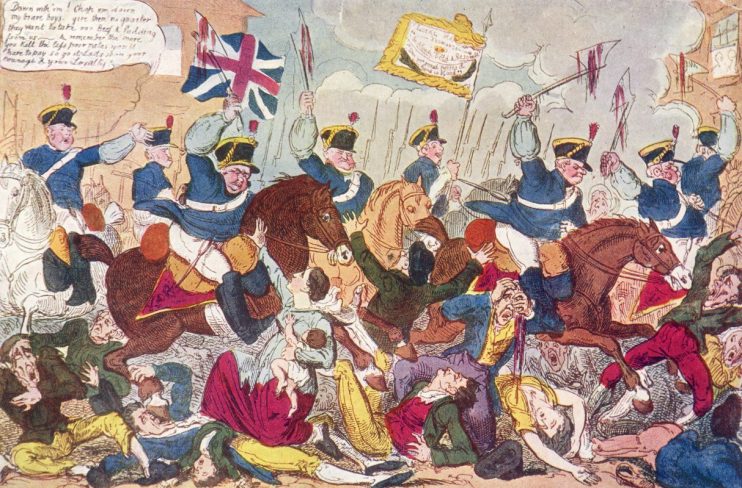
Historical depiction of Peterloo Massacre with crowds and mounted soldiers in St Peters Field, Manchester, in early 19th c...
18th August 1819: 'The Massacre of Peterloo or Britons Strike Home'. British soldiers charging the crowd at St Peter's Fields, Manchester, during a meeting called in support of political reform. Original Artist: By George Cruikshank (Photo by Spencer Arnold Collection/Hulton Archive/Getty Images)

The mechanisation of weaving in the 19th century didn’t just affect jobs, it led to years of political unrest culminating in the Peterloo Massacre. Leaders had better be ready for what’s coming with AI, says Paul Ormerod

Last week the US AI company Anthropic released a tool which it says can automate legal work such as contract reviewing compliance workflows and templated responses.

The software does not provide legal advice. Rather, it enables fairly routine tasks to be carried out much more cheaply.

Major law firms themselves have already been investing in this type of analysis. As a result, employment is being cut. Clifford Chance, for example, announced in November that they were reducing their business support staff by 10 per cent.

This brings into sharp focus the key question as to whether revolutionary new technology destroys or creates jobs.

On the positive side, by making particular goods and services cheaper, consumers and firms in general have more money to spend on other things. In addition, the technology may generate types of jobs which did not previously exist.

But, as with the legal services example, new technology has the immediate and direct impact of replacing workers.

The question is as old as the Industrial Revolution itself.

The first industry to bear the brunt of a wave of revolutionary inventions in the late 18th century was the textile industry.

In the mid-18th century it took around 50,000 person hours to spin 100 pounds of raw cotton into a form which could then be weaved. By 1800, this could be done in 300 hours.

The textile industry experienced a massive boom. But what about the workers?

The great English economist David Ricardo – a self-made millionaire in early 19th century money – thought about this in the various editions of his magnum opus, The Principles of Political Economy.

His initial thinking reflected what have become the classic positive points mentioned above. But he became gloomier and began to argue that “machinery”, as he called the new technology, would destroy jobs.

Read more

Kroll chief Jacob Silverman: AI won’t kill ‘mission critical’ advisory work

Kroll

Ricardo’s views were influenced not so much by what happened to the spinners of cotton because the growth in the industry was so huge that it created jobs. It was the second wave of new technology in the early 19th century which destroyed the jobs of the weavers of the spun cotton.

Weaving was a skilled trade, often carried out from home on handlooms. Initially, the workers prospered as the huge increase in the production of cotton yarn increased the demand for their services.

But they were soon driven into appalling poverty by the introduction of power looms into factories.

In the newly industrialising areas of the North where textiles were made, and especially in the Greater Manchester home of the Industrial Revolution, there was widespread and prolonged civil unrest.

The Handloom Weavers Lament

A poem, widely known at the time, captured the problems. Entitled “The Handloom Weavers’ Lament”, it is full of references to wages being “pulled down” and to the dire poverty being endured.

But it also denounces both the mill owners and the government as “tyrants”.  

At a mass gathering in Manchester in 1819, militia fired upon and killed members of a huge protesting crowd in what is known as the Peterloo Massacre.

Throughout the 1820s, the British government carried out repressive domestic policies

These were resisted in several places. For example, Oldham was essentially in a revolutionary situation. Although the positions of magistrates and poor law supervisors in the major textile town were still held by the local gentry, they were so terrified of local sentiment that in practice they carried out the demands of the militant working class.

Gradually things quietened down. The handloom weavers died off, real wages began to rise and economic growth generated jobs. But the process took at least a couple of decades.

The government, whoever is leading it, needs to be planning now for the possibility of big redundancies in the next few years.

Paul Ormerod is an Honorary Professor at the Alliance Business School at the University of Manchester.  You can follow him on Instagram @profpaulormerod

Read more

Octopus acquires legal team to boost bereavement services with AI

Octopus displaying vibrant colors and intricate patterns in a marine environment, showcasing its natural habitat and behavior

Share this article

  • Facebook
  • X
  • LinkedIn
  • WhatsApp
  • Email

Similarly tagged content:

Sections

  • Opinion

Categories

  • Opinion

People & Organisations

  • artificial intelligence
  • peterloo massacre

Trending Articles

  • As it happened: FTSE 100 relief rally runs out of steam as BP and Shell weigh; Oil hits three-month low

  • London Tech Week sums up everything wrong with UK tech

  • KPMG’s Summer Friday half-day rollback signals deeper woes for Big Four giants

  • Rolls-Royce shares surge as SMR unit bags multi-billion pound Swedish nuclear contract

  • Inflation expectations at record high in interest rates signal

More from CityAM

  • Kroll chief Jacob Silverman: AI won’t kill ‘mission critical’ advisory work

    Advisory
    Kroll
  • Octopus acquires legal team to boost bereavement services with AI

    AI
    Octopus displaying vibrant colors and intricate patterns in a marine environment, showcasing its natural habitat and behavior
  • Deputy PM to unveil AI labs to drag legal sector out of ‘analogue’ age

    Legal
    David Lammy speaking at a press conference, addressing key issues in current political landscape, wearing a formal suit.
  • Everlaw and Legora Partner to Create End-to-End AI Litigation Workflows

    Business Wire
  • Burges Salmon and Wexler roll out firm-wide legal AI partnership

    Legal
    Burges Salmon partners with legal tech startup Wexler to enhance AI-driven litigation support for UK lawyers
  • Elite law firm to splash £370m on building own AI tool

    Legal
    Kirkland & Ellis office building exterior showcasing modern architecture and business district setting
  • Avantia, Hoxton Ventures’ Portfolio Company, Acquired By Carta

    Business Wire
  • Quantexa chief says £175m HMRC deal will ‘protect taxpayers’ money’

    Tax
    Inheritance tax receipts are on track for a record breaking year
  • Terms & Conditions
  • Privacy Policy
  • Cookie Policy
  • News
  • Markets & Economics
  • Politics
  • Opinion
  • Life&Style
  • Personal Finance

Follow us for breaking news and latest updates

  • Facebook
  • X
  • Instagram
  • LinkedIn
Copyright 2026 CityAM Limited