
What is an asset class?


Today, diversification and alternative returns are our top portfolio concerns. Why? Because low interest rates may have driven valuations of stocks, bonds, and other asset classes to unsustainable heights, so we’re forever on the lookout for uncorrelated assets to incorporate into our portfolios.
And of course, product providers are all too happy to accommodate us, touting everything under the sun as a new asset class that can diversify our risk.
But let’s take a step back and consider what an asset class is in the first place.
There is no universally accepted definition. Some describe it as a financial asset with certain cash flows. But then commodities wouldn’t qualify. So maybe an asset class has to pay a risk premium. But then cash and money market investments wouldn’t count either.
Here’s the definition I’ve been using:
An asset class is a group of assets with similar exposure to the fundamental drivers of the economy.
Joachim Klement
The problem with this interpretation, of course, is that it simply shifts the question one level up. It’s like saying that life didn’t start on Earth but was brought here by aliens. But how did alien life start, then?
So, the ultimate question is, What are the economy’s fundamental drivers, and how do they influence different asset classes?
The economy has many drivers, but only a handful really make a difference. Those are:
- Growth
- Inflation
- Human ingenuity
- Labor
- Land
- Resources and infrastructure
- Greed
Some of these — growth, inflation, and human labor — are self-explanatory. Others require a bit more context.
What I mean by greed is the human desire to want more of everything, money in particular. The urge to create more wealth out of existing capital is at the heart of the entire financial industry. A bank lends money to corporations and private households to earn interest. Hence, all credit-related assets, whether corporate and high-yield bonds or mortgages, are exposed to our collective tendency not to be satisfied with what we already have. Hence, the credit cycle — essentially a cycle of greed and fear — is an expression of our fundamental human nature.
Human ingenuity — our drive to make things better over time — is another key contributor. Economists often use productivity as a catchall, but human ingenuity speaks to what is innate in us: We ask questions and seek answers. This propels productivity growth as we strive to solve our problems and build a future that is better than the past.
Of course, a society can hardly function without the space to feed, house, and employ itself. Hence, land — and its location — is a critical component of the economy.
But land isn’t the only input factor the economy requires. It also needs raw materials, most of which are still derived from natural resources, both renewable and non-renewable. And infrastructure is necessary to transport those raw materials to the production centers and on to the end consumer. These input factors are distinct from land because they are not as finite. New input factors can be created by, say, opening a mine or constructing a road. But new land is not so easily built from scratch.
My list leaves out the real interest rate, among other factors, that some may consider fundamental. But real interest rates are effectively set in reaction to growth and inflation expectations as well as other criteria, so it doesn’t quite qualify.
Mapping the asset classes and their fundamental drivers
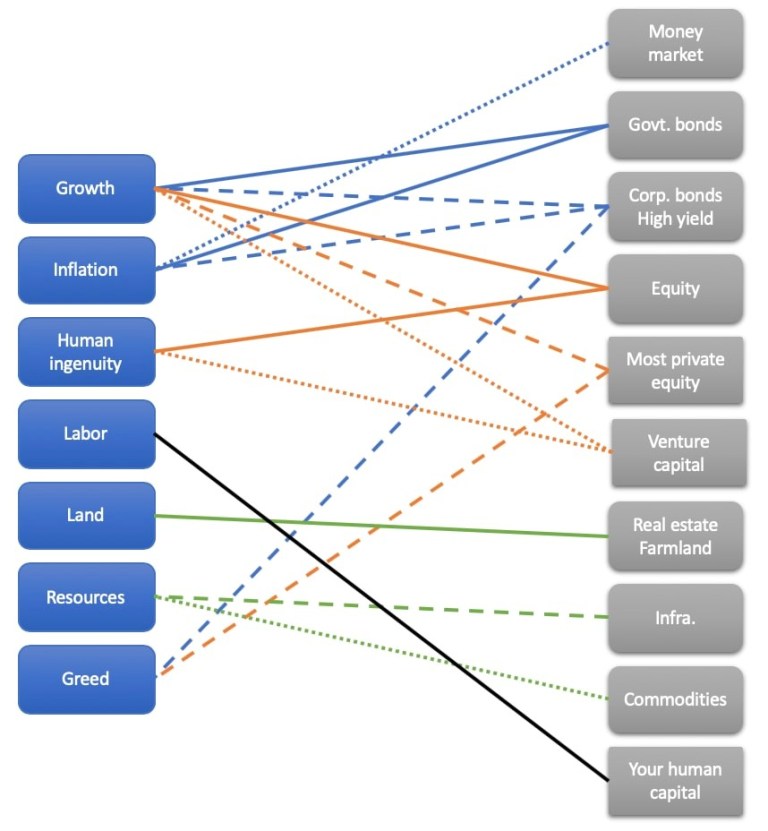
Based on the above analysis, every asset class can be mapped according to its exposure to these various drivers. Stocks, for example, are driven mostly by economic growth and human ingenuity. Yes, inflation and other factors have an influence, but stock returns are primarily a function of the economy’s rate of overall growth and how well entrepreneurs and businesses increase productivity and develop new products and services that people want.
Government bonds are driven by the inverse of growth — slower growth, meaning higher bond returns through declining real rates — and inflation. And where there’s credit exposure, there is greed. After all, why else would we bother with corporate or high-yield bonds instead of safe government-backed Treasuries?
Private equity’s main driver is economic growth. With venture capital, human ingenuity is the main one. Leveraged buyouts are principally about greed since their higher returns are fueled by the use of debt.
And what about hedge funds? To me, they don’t constitute an asset class on their own but are rather a composite of the various asset classes in which they invest. They’re a form of active management that seeks to generate more return for a given level of risk than could otherwise be achieved with passive investments. They are driven by greed.
The following chart maps the different asset classes to their various fundamental drivers.
What it all means
All these reveals something both important and obvious: We don’t need many different asset classes in our portfolios.
The deluge of “alternative” assets are mostly a rehash of exposures to these various fundamental drivers.
So the next time someone comes along promoting the benefits of, say, aircraft leasing as an asset class, we can refer to the chart and see that this “asset” is simply an expression of greed: It’s a credit instrument with a touch of economic growth exposure thrown in. Which, if we already have stocks and high-yield exposure in our portfolio, won’t add much in the way of diversification benefits.
Many alternative asset classes aren’t truly different. This tends to become glaringly obvious when a crisis hits and all the “uncorrelated” alternative assets suddenly nosedive in tandem with stocks. So why not avoid such a painful realization?
After all, all markets do is focus on the exposure to these fundamental drivers and their expected future development. So by breaking down what our assets are exposed to, we can anticipate how they’ll react in a crisis.
Visit CFA Institute for more industry research and analysis.
If you liked this post, don’t forget to subscribe to the Enterprising Investor.
By Joachim Klement, CFA, a CFA Institute contributor.
All posts are the opinion of the author. As such, they should not be construed as investment advice, nor do the opinions expressed necessarily reflect the views of CFA Institute or the author’s employer.
Image credit: ©Getty Images