
Wimbledon won’t slap sponsor on new show court but eye US growth

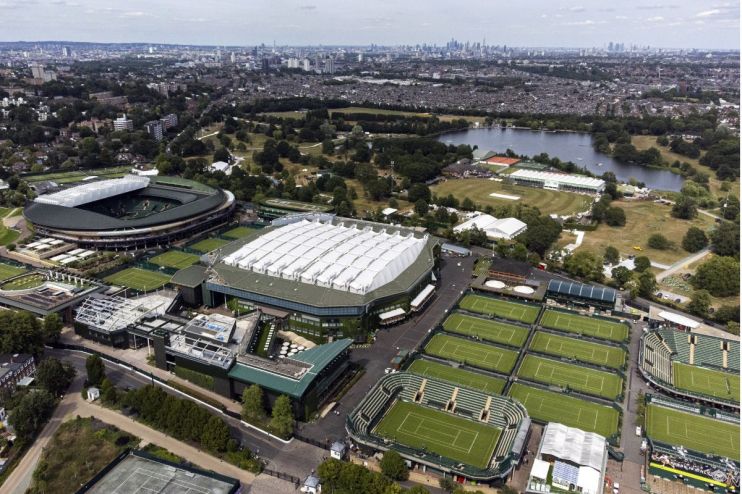
Wimbledon is quintessentially British, and its branding is understated. But what’s next for the Grand Slam? Matt Hardy finds out.
“I’m not sure it’s Wimbledon style to have a naming right on a court,” the tennis Grand Slam’s marketing and commercial director Usama Al-Qassab tells CityAM when asked whether a new show court at the centre of the proposed SW19 site expansion should be slapped with a sponsor’s branding.
It is a quintessentially Wimbledon answer to a question surrounding the aesthetics of one of Britain’s great sporting exports.
“We believe in our traditions, and Wimbledon is the brand. That is the Championships, and our players are our actors on the most amazing stage and field of play,” Al-Qassab adds.
He says that the expansion is a necessary next step for the Championships with the Wimbledon site maxed out at 550,000 attendees each year. “Being able to expand the Wimbledon Park isn’t just good for the tennis community, it’s good for British tennis.”
Wimbledon in expansion mode
Sport is bursting with investment; firms and individuals alike are looking for the next square inch of space in which to slap their logo on. It’s not Wimbledon’s style, it never has been. Next year it will celebrate its 125th anniversary with Slazenger, in the year Wimbledon turns 150.
It is 48 years into its Rolex deal and decades in with the likes of IBM – with a clean court policy that sees logos kept to a minimum on Centre Court.
“We choose to have a clean court, which means that it stands out, versus having logo soup, as we call it, and we find ways of being able to have very unique propositions for each of our official partners,” Al-Qassab says.
“There’s a world of opportunity. We are incredibly pleased with our official partnership portfolio. You don’t see it chop and change like you do in other places and other tournaments, and that is because we add true value and we work long term with them on very specific plans.”
And that world of opportunity extends beyond the UK, too, and towards the United States.
New York growth
Wimbledon bigwigs are five years into a New York activation that this year saw them construct a grass court in the city’s Central Park, dubbed Central Court.
Even such traditionalists understand sport is global, and crowded. Heritage brands cannot sit still because other projects – such as the Saudi National Centre and the Tie Break Tens – are gunning for eyeballs.
“ that you can be a global powerhouse in sport without winning beyond your own borders,” Al-Qassab adds. “Just look at what Fifa has done with the World Cup – taking that to the US and driving engagement around the world.
“We do focus on the US because it’s very difficult to win globally in sport unless you win in the US itself. The US is the largest sports marketplace in the world and in order to cut through against the powerhouses of the NBA, NFL, NHL, MLB you really need to stand out.”
Walking around the grounds of the All England Club, one imagines, is akin to strolling around the very same courts 100 years ago: greenery, flowers and an aura of heightened self-worth. That remains the power of Wimbledon.
They would be foolish to stray from that when the proposed expansion is completed, and in a world where organisations are climbing the same greasy pole looking for fandom there is a reassuring attitude oozing from Wimbledon that they know what they are and, because of that, people will continue to flock to everything green and purple.