Skip to content
CityAM
Main navigation
  • News
    • News
      • Latest Business News
      • Economics
      • Politics
      • Tech
      • Banking
      • FTSE 100 Live
      • Retail
      • Insurance
      • Legal
      • Property
      • Transport
      • Markets
    • From our partners
      • AON
      • Bayes Business School
      • Canada BIDs
      • Central London Alliance CIC
      • Destination City
      • Halkin
      • Olympia
      • Inside Saudi
      • Tottenham Hotspur Stadium
      • Santander X
      • YEAR SIX Dividend
    • Featured

      The next person to shop your store may not be a person at all

      AI shopping agents are rewriting the rules of online retail across North America

      Submit a story

      Tell us your story.

      Submit
  • Opinion
  • Sport
    • Latest Sports News
      • Sport
      • Sport Business
    • From our partners
      • The Morning Briefing: SBS x CityAM
      • Aramco Team Series
      • LIV Golf
    • Featured

      Cohere's Aidan Gomez bets the house on 'sovereign AI' with Aleph Alpha merger valuing the group at $20bn

      Cohere CEO Aidan Gomez on stage discussing the Toronto AI lab's strategy

      Submit a story

      Tell us your story.

      Submit
  • Life&Style
    • Life&Style
      • Life&Style
      • Toast the City Awards
      • The Magazine
      • Travel
      • Culture
      • Motoring
      • Wellness
      • The RED BULLETiN
      • Do it with Shared Ownership
      • Media Speak Hub
    • Featured

      Moonvalley's Naeem Talukdar is selling Hollywood the one thing rival AI video tools cannot: legal cover

      Moonvalley's Marey AI video model produces Hollywood-grade footage trained on licensed data

      Submit a story

      Tell us your story.

      Submit
  • Investec
  • Events
  • Latest Paper
Wednesday 06 May 2026 5:03 am  |  Updated:  Tuesday 05 May 2026 5:32 pm

Fractile vs Nvidia: can a UK startup undercut AI’s chip darling?

By: Saskia Koopman

Tech Reporter

Add as a preferred source on Google
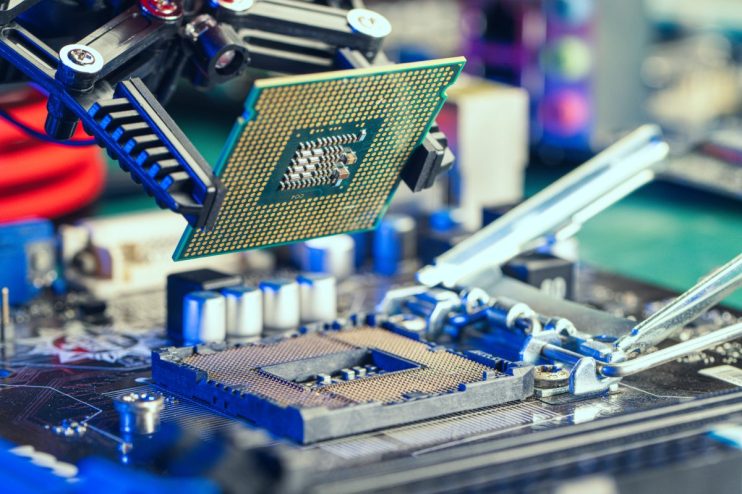
Advanced semiconductor chip with intricate circuit patterns and microcomponents, highlighting cutting-edge technology.
The numbers also pointed to the shift in Arm's own strategy

A little-known British startup is beginning to test one of the biggest assumptions underpinning the AI boom: that Nvidia will remain the unavoidable centre of the ecosystem.

Founded in 2022 by Oxford researcher Walter Goodwin, Fractile is attempting to redesign how AI chips work altogether, with a focus on speed and – crucially – cost.

The first phase of the AI boom was categorised by the ability to build ever-larger models.

Now it’s about running them, and doing so cheaply enough to sustain real-world deployment at scale.

A different way to build AI chips

Nvidia’s GPUs, originally designed for graphics processing, became the backbone of AI because of their ability to handle parallel workloads.

However, they were never purpose-built for modern large language models like the ones we rely on today.

Their core limitation is architectural – data must constantly move between the processor and separate memory (DRAM).

This movement creates latency, consumes vast amounts of energy and acts as a brake on performance.

Fractile’s approach to chip-making aims to eliminate that hurdle, by making chips that fuse memory and compute together, relying on high-speed DRAM so that data can be processed where it sits.

In theory, that process reduces the need for data transfer, which is the single biggest constraint in current AI systems.

The company has claimed that, based on simulations, this could allow models to run significantly faster and at a fraction of the cost of today’s GPU-based systems.

Nvidia is being challenged, but not replaced

Its software ecosystem and integration across cloud providers create a moat that is extraordinarily difficult to cross.

Read more

Fractile lands $220m as ministers hail ‘vote of confidence’ in UK AI

Kanishka Narayan, prominent figure in the news, engaging in a public event or discussion, showcasing leadership and influe...

For most companies, Nvidia remains the default, not necessarily because it is cheapest, but because it is the easiest and most reliable.

Yet AI developers are increasingly constrained by supply, cost and power availability.

Running models at scale is expensive, and margins are under pressure – particularly for companies like Anthropic, which rely heavily on third-party infrastructure.

That squeeze is driving a shift towards diversification like Google’s TPUs or Amazon’s Trainium, and now a new generation of specialist chips focused on inference efficiency.

And Fractile, it seems, sits squarely in that latter emerging category.

Startups like Fractile are betting that purpose-built hardware, designed specifically for AI workloads, can unlock a step-change in both speed and cost.

If that proves true, it could reshape how AI systems are deployed, and who controls the economics behind them.

A credible challenger

Fractile’s chips are not yet in commercial use, and the timeline to deployment stretches into the latter part of the decade.

The gap between simulation and scaled production has undone many promising chip startups before.

And Nvidia is not standing still, as it shifts into more specialised AI hardware, acknowledging the same pressures that startups are targeting.

Still, the emergence of credible alternatives, particularly from a small, UK-based company, shows that more players are beginning to run with the big dogs.

Read more

Barclays names Fractile and Isomorphic Labs among UK’s top AI startups

AI data center with rows of servers and cooling systems, showcasing advanced technology and infrastructure innovation

Share this article

  • Facebook
  • X
  • LinkedIn
  • WhatsApp
  • Email

Similarly tagged content:

Sections

  • News

Categories

  • Business
  • Tech

People & Organisations

  • AI
  • artifical intelligence
  • fractile
  • Nvidia
  • nvidia chips

Trending Articles

  • Can football conquer the US? Why culture is key this World Cup

  • Starmer agrees investment deal with Japan as EU deal questioned

  • Elon Musk becomes world’s first trillionaire after SpaceX mega float

  • US and Iran agree to peace deal’s text, negotiators say

  • Thames Water, energy grid, rent prices: Burnham drums up public control agenda

More from CityAM

  • ZayZoon, the Calgary fintech born on a fishing boat, posts 1,487% growth as earned wage access goes mainstream

    ZayZoon co-founder Tate Hackert built the Calgary fintech around earned wage access
  • Botpress raises $25m as Quebec's Sylvain Perron pitches his startup as the 'infrastructure layer' for AI agents

    Botpress product UI: the Quebec startup pitches itself as the infrastructure layer for enterprise AI agents
  • FluidAI wins US FDA clearance for its surgical monitor as Waterloo's Youssef Helwa targets 100,000 operations

    FluidAI's Origin surgical monitor wins FDA clearance for use in US hospitals
  • Labour bets £1.1bn on Britain’s AI chip race

    Tech
    Work and Pensions Secretary Liz Kendall is in charge of reforming the state pension and benefits system
  • Nvidia beats again – but Wall Street’s expectations keep rising

    Tech
    OpenAI and NVIDIA announced strategic partnership to deploy 10 gigawatts of Nvidia systems
  • Nvidia must ‘step up to the plate’ after $1.5 trillion rally

    Tech
    Nvidia CEO Jensen Huang speaking at a tech conference, emphasizing AI advancements and industry innovation.
  • Kospi breaks 7,000 mark as Samsung becomes trillion-dollar company

    Markets
    Samsung has missed earnings expectations
  • Arm’s AI ambitions hit supply chain reality despite record revenues

    Tech
    Advanced semiconductor chip with intricate circuit patterns and microcomponents, highlighting cutting-edge technology.
  • Terms & Conditions
  • Privacy Policy
  • Cookie Policy
  • News
  • Markets & Economics
  • Politics
  • Opinion
  • Life&Style
  • Personal Finance

Follow us for breaking news and latest updates

  • Facebook
  • X
  • Instagram
  • LinkedIn
Copyright 2026 CityAM Limited