Skip to content
CityAM
Main navigation
  • News
    • News
      • Latest Business News
      • Economics
      • Politics
      • Tech
      • Banking
      • FTSE 100 Live
      • Retail
      • Insurance
      • Legal
      • Property
      • Transport
      • Markets
    • From our partners
      • AON
      • Bayes Business School
      • Canada BIDs
      • Central London Alliance CIC
      • Destination City
      • Halkin
      • Olympia
      • Inside Saudi
      • Tottenham Hotspur Stadium
      • Santander X
      • YEAR SIX Dividend
    • Featured

      Why 2026 World Cup is when AI becomes the interface between fans and football 

      GettyImages 2280946892: Professional meeting with diverse business executives discussing strategies in a modern office set...

      Submit a story

      Tell us your story.

      Submit
  • Opinion
  • Sport
    • Latest Sports News
      • Sport
      • Sport Business
    • From our partners
      • The Morning Briefing: SBS x CityAM
      • Aramco Team Series
      • LIV Golf
    • Featured

      Why 2026 World Cup is when AI becomes the interface between fans and football 

      GettyImages 2280946892: Professional meeting with diverse business executives discussing strategies in a modern office set...

      Submit a story

      Tell us your story.

      Submit
  • Life&Style
    • Life&Style
      • Life&Style
      • Toast the City Awards
      • The Magazine
      • Travel
      • Culture
      • Motoring
      • Wellness
      • The RED BULLETiN
      • Do it with Shared Ownership
      • Media Speak Hub
    • Featured

      Fogo de Chao nominated for Best Casual Dining Toast award

      Fogo de Chão restaurant exterior with vibrant signage and bustling entrance at popular city location

      Submit a story

      Tell us your story.

      Submit
  • Investec
  • Events
  • Latest Paper
Tuesday 01 August 2023 6:00 am  |  Updated:  Tuesday 01 August 2023 11:05 am

Are central banks to blame for the inflation crisis?

Central banks, though, as economist Mohamed El-Erian puts it, aren’t the “only game in town”. They are simply inflation stabilising vehicles navigating the economic conditions handed to them (Photo by Win McNamee/Getty Images)

As we enter what looks like the final leg of central banks’ interest rate rising journeys, it’s as good a time as ever to trace why they have been jolted into action after over a decade of ultra loose policy and whether their response to the inflation crisis has been effective.

Coming out of the worst of the pandemic in the summer of 2021, central banks should have seen that the conditions for inflation to return were lurking in the corners of the global economy.

International supply chains were stretched by a combination of ports suddenly closing at short notice due to virus outbreaks, workers being forced to stay at home and unusually high goods spending overwhelming suppliers.

Once lockdowns ended and citizens gradually returned to normal spending habits, demand for essential items like energy came roaring back, colliding with strained supply.

Judging these trends to be “transitory”, as the Federal Reserve, ECB and Bank of England did at the time, can be seen as justifiable. Staff would eventually return from the pandemic. There was little reason to think spending wouldn’t rebalance. Oil, gas and electricity production would rise in response to higher prices.

The bigger concern for central banks was that they didn’t know what shape their respective economies would be in after two years of being ravaged by the pandemic, delaying the start to their tightening cycles. 

That’s not to say interest rate rises weren’t required. Signalling an inflation intolerance to financial markets, households and businesses helps retain credibility. Quantitative easing probably lasted too long and was too generous.

As such, the rate rises (finally) came. The Bank went first in December 2021, lifting borrowing costs to 0.25 per cent from 0.1 per cent. The Fed followed in March 2022, then the ECB fired its gun in July 2022.

UK, Eurozone and US inflation rates

Source: ONS, Eurostat, US Bureau of Labor Statistics

Everything changed in February 2022. Russia’s full-scale invasion of Ukraine could not have been foreseen. Its ramifications in energy and food markets were huge.

CPI in the UK jumped two percentage points in April to nine per cent. That was the biggest month on month annual increase since June 1979, according to modelled data from the Office for National Statistics.

In the US and eurozone, prices raced ahead. The dynamics required novel responses from central banks and they delivered. The Fed launched four 75 basis point rises. The ECB’s first increase was a smaller 50 basis points.

Those on Threadneedle Street were spurred into such action not by inflation but by the haphazard tax and spending decisions of Liz Truss during her premiership. 

Read more

Bank of England says quantitative easing programme to cost taxpayer £125bn

The Bank of England is expected to hold interest rates at four per cent due to stubbornly high inflation.

Kudos must be given to the Bank for its handling of that episode. It launched an emergency short-lived bond buying programme to hose down a fire in UK debt markets. Its 75 basis point increase went a way to tame higher inflation expectations.

­­Jerome Powell and co at the Fed have arguably been more aware of stimulative fiscal policy nudging up inflation. They went faster and steeper than their peers, partially to offset Americans pumping the up to $2,800 of parachute payments they received during the pandemic into the economy.

FOMC officials were also grappling with an inflation problem that was more demand driven, a factor that monetary policy is better at influencing. 

Energy support packages were rolled out across Europe. France erected a more than €100bn support scheme, including capping prices. Germany doubled that gift. UK policymakers froze bills at £2,500.

Cumulative tightening by ECB, Fed and BoE
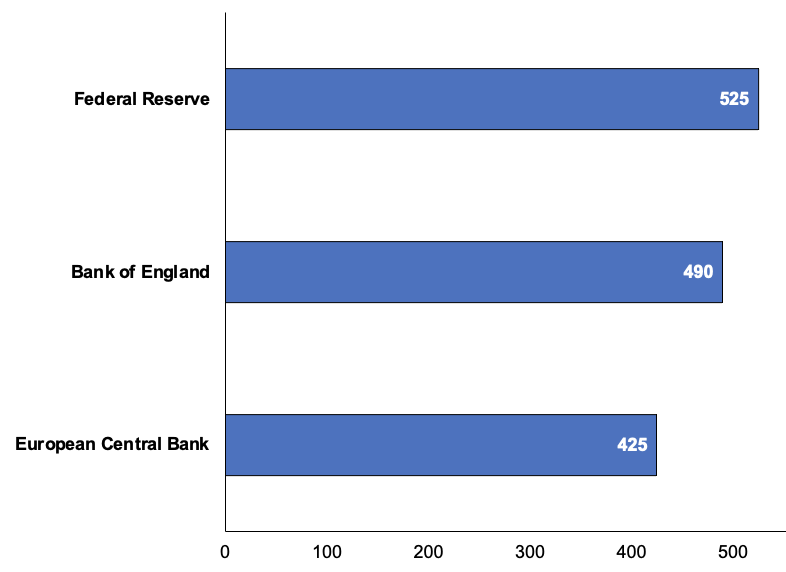
Source: ECB, Fed and BoE (basis points)

All these measures were designed to blunt the initial shock from soaring gas prices. They were necessary to avert a living standards catastrophe.

By partly shielding incomes, governments supported spending and inflation. The tension between monetary and fiscal policy was there for all to see.

So how have central banks done? Inflation is three per cent in the US (lower than Japan), 5.3 per cent in the Eurozone and 7.9 per cent in the UK – all above target.

Doubtless the Fed, ECB and Bank of England have had some of their credibility knocked. Those on Threadneedle Street should be regretful of their terrible forecasting record over the last 18 months.

Central banks, though, as economist Mohamed El-Erian puts it, aren’t the “only game in town”. They are simply inflation stabilising vehicles navigating the economic conditions handed to them. To prevent future inflation flare ups, politicians and business leaders must be bolder. 

Investment needs jolting, Infrastructure renewed, better jobs created. Mere tweaks to interest rates will not cut it.­­­

WHAT I’M READING

There were some interesting stats in the Bank of England’s monthly money and credit report yesterday. Brits took on an additional £1.7bn of debt in June, £600m of which was from spending on their credit card. Perhaps that suggests families aren’t too bothered about higher interest rates. Or maybe elevated living costs are steering them towards debt. The overall sentiment of the snapshot though was that the full effects of the Bank’s 13 straight interest rate rises have yet to really crunch the economy. Home loans actually rose to 54,700 despite the initial stages of the mortgage rate surge taking place in June. P.S. This is my last column, but you can catch me over at The Thunderer in a couple weeks still jabbering about economics…

Read more

Record number of central banks plan to increase gold holdings amid global volatility

Investors have been piling into gold for several reasons (Photo by Chris McGrath/Getty Images)

Share this article

  • Facebook
  • X
  • LinkedIn
  • WhatsApp
  • Email

Similarly tagged content:

Sections

  • Markets & Economics
  • News
  • Opinion

Categories

  • Economics
  • Opinion

Related Topics

  • Bank of England
  • Eurozone
  • Eurozone inflation
  • Federal Reserve
  • UK inflation
  • UK interest rates

Trending Articles

  • FTSE 100 Live: Pound dips and stocks slip as Andy Burnham victory triggers political uncertainty

  • Kaleb Cooper: Brits don’t care about the price of milk 

  • Judge rejects Gatwick Airport bid to block new relaxed runway slot rules

  • PwC UK chief swipes global role in international shake-up

  • Inheritance tax enquiries surge to six-year high after HMRC clampdown

More from CityAM

  • Bank of England says quantitative easing programme to cost taxpayer £125bn

    Economics
    The Bank of England is expected to hold interest rates at four per cent due to stubbornly high inflation.
  • Record number of central banks plan to increase gold holdings amid global volatility

    Investing
    Investors have been piling into gold for several reasons (Photo by Chris McGrath/Getty Images)
  • Inflation, not Andy Burnham, is the culprit behind high Gilt yields

    Opinion
    Burnham smiling broadly at a community event, surrounded by enthusiastic supporters, conveying a sense of positivity and u...
  • FTSE 100 banks are facing £2.5bn of headwinds – HSBC and Barclays are in the firing line

    Banking
    City banks could be in for a tax raid come the Autumn Budget.
  • Mining boss: Platinum to become a central bank reserve asset

    Mining
    Platinum bars stacked in a vault, illustrating the surge in platinum prices as they doubled in 2025.
  • Gold prices glitter amid geopolitical uncertainty

    Investing
    Gold jewelry displayed in Indian market as gold price hits record $5,097 amid Trump tariff turmoil and investor demand
  • It’s not the Bank of England’s job to support the Chancellor

    Opinion
    Andrew Bailey, Bank of England governor, discusses economic policy during a press conference at the central bank headquart...
  • Bank of England unveils Armageddon stress test scenario ‘more severe than the financial crisis’

    Regulation
    bank of england

CityAM Canada — business, markets and opinion for Canadian readers.

Sections

  • Business
  • Markets
  • Tech
  • AI
  • Economics
  • Opinion
  • Cities

Company

  • About
  • Contact

Legal

  • Terms of Use
  • Privacy Policy
  • Cookie Policy
© 2026 CityAM Canada. All rights reserved.
Terms · Privacy · Cookies