Britain would have left the EU even if it had voted Remain

Counterfactuals are the ugly stepsister of political risk analysis, neglected and scorned in equal measure because – as they deal with events that have never occurred – they can never be definitively assessed.
We find this all more than a little amusing, as the first rule of any world-class analyst is humility, that nothing (good as you are) can ever be truly definitively assessed. Looked at in this new light, counterfactuals – positing alternative courses of events to what happened – can actually yield very creative and rich insights. Let us start here with the notion that the historically decisive Brexit referendum had ended very differently: UK voters decide by a clear but close 52 to 48 per cent to stay in the European Union.
Ironically, the most likely outcome of such a vote is that the UK would have had to leave the EU just a few years down the road, as either Brussels would have become far more centralised, or the whole thing would have fallen apart (or both). Britain would then have had to leave the Titanic and frantically make for the lifeboats, rather than (as has just happened) gently disembarking at Cobh, its last port of call before the deadly rendezvous with an iceberg.
Recent news reports from Italy provide some unexpected context. Take, for starters, the coverage of the Italian, French and German leaders’ meeting on an aircraft carrier, the Garibaldi. The full symbolism of the event is jaw-aching.
That warship had been engaged in supporting the military operations during the Libyan civil war that brought down Muammar Gaddafi. To the intense embarrassment of Rome, however, the ship was pulled from active duty half way through operations. Because of the Eurozone-driven budgetary crisis, the defence ministry had reportedly run out of money to pay for its fuel. As a metaphor for the hollowness of the EU’s superpower ambitions, the Garibaldi is an inspired choice.
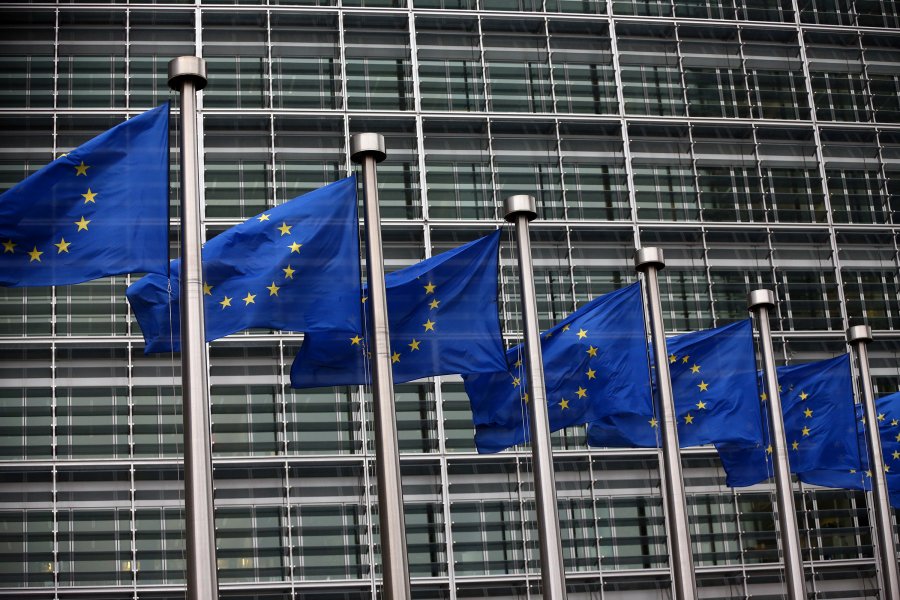
The EU is a hollow power (Source: Getty)
The only way forward for European defence aspirations is far more centralisation to the exclusion of dominant Nato (which both London and Washington won’t wear) or more comic escapades like the Garibaldi, pointing out Brussels’s total strategic irrelevance. Neither or these choices are remotely palatable for the UK.
The tragedy of the recent Amatrice earthquake in Italy separately reminds us of the “Disaster Clause” in the Lisbon Treaty. That article was introduced precisely to help with such catastrophes, by giving a member state a formal mechanism for asking for assistance from its EU allies. The potential for cataclysm is a known threat in that part of the world: the largely-forgotten Messina earthquake and tsunami may have killed as many as 100,000 people, and as recently as 1908.
The logic for putting the clause in the treaty thus may have been solid, but its recent monetary application proved otherwise. It was most infamously triggered for entirely spurious reasons, as a mechanism to tap non-Eurozone countries to provide billions in disaster relief for an entirely man-made fault line – Greek debt, brought on by the catastrophic decision to introduce the euro. Again centralisation through the backdoor – a hallmark of EU decision-making – surely would not have been borne by London for much longer.
Read more: Will Europe have to abandon the euro to save the European project?
The reality is that, for EU institutions, self-interested treaty abuse, power grabs, and Walter Mitty ambitions can no more be avoided than the scooping fingers of a three year old in a jam jar. The only way to make the jam safe is to put it out of reach, and that means taking absolutely all the social, pan-governmental and fiscal competences out of the trade treaties. That guarantee in turn can only be achieved by Brexit.
As it becomes obvious that, for Brussels, the choices will be further centralisation or utter irrelevance (and likely both), our counterfactual should be remembered; neither of these medium-term trajectories would have suited Britain at all.
For their part, the problem EU leaders face is that key parts of their political construct are still bubble and froth. A fully working model demands a far higher level of integration. Given that majorities in many countries – if asked – would oppose transforming the EU into a federal union, such an end state has only ever been achievable by two processes: in bounds by fear and urgency, or over time by torpor and denial.
The question has never been about the direction, only the timeframe. So far the EU’s builders have followed the second route: it now seems likely they will choose the former. In either case our counterfactual holds; given the obvious possible directions of the lumbering behemoth that is the EU – centralisation, irrelevance, or both – Britain would soon have left it behind, one way or another. Here’s to the British people for making our counterfactual just that.