Can an AI make art? And would it be worth looking at?

The last year has seen artificial intelligence disrupt almost every industry – but can it really create art? Chris Dorrell speaks to artists working with AI and meets a robot painter
In a darkened room in Camden, I kneel at an altar, pressing buttons on an illuminated red keyboard. Embossed with the shapes of human body parts, the grotesque buttons prompt words to move around a screen, sometimes forming sentences and other times displaying nonsense.
“Seek the path of truth,” I could just about make out. “Woe to the hills where the raven cries. Woe to the mighty who defy the Lord.” I hoped the next button would reveal the full meaning but the letters devolved beyond comprehension.
Behind me, computer generated prophets re-enact Biblical scenes against an empty backdrop. Their movements re-imagine the “agonies and trials” of the Old Testament prophets, embodying the frustrations at a world that failed to heed their warnings.
Both displays form part of an exhibition called Prophecy by the artist Auriea Harvey at the Arebyte Digital Art Centre. Across the installation Harvey uses AI to bring her imagination to life, whether by programming the movements of the prophets or guiding the creation of my fragmentary prophecies.
AI: The good the bad and the evil
It’s easy to feel pessimistic about the creative potential of AI, especially when faced with the ever-increasing quantity of slop that now permeates the online experience. The desire to retreat to something more authentically ‘human’ seems only natural. But artists are inevitably engaging with AI, both as a topic and a tool. Often their work serves as a prompt to interrogate the nature of these new technologies and the role of humans within them.
“Every material you use will have its own history, associations, and connotations,” says Anna Ridler, an artist and researcher based in London. “Machine learning is no different. I’m interested in thinking through those associations and histories as part of my work.”
In 2019, Ridler exhibited two works at the Barbican’s More Than Human exhibition, about AI and art. For the first, Myriad (Tulips), she took 10,000 photographs of flowers and categorised them by hand according to colour and the state of the flower. The photos were then projected over 50 square metres, parts of which were displayed around the world.

Myriad (Tulips) formed the training set for the second artwork, Mosaic Virus. Here, a ‘generative adversarial network’ – a kind of machine learning framework – produced an image of what it thought a tulip should look like, based on the dataset. Across three screens, the AI-generated tulips changed colour and shape depending on the price of bitcoin, becoming more stripy as the cryptocurrency gained value and less as it declined.
Like Harvey, Ridler found that the AI produced surprising things. “For some reason generative adversarial networks really, really love red. It would just produce way more red flowers than anything else, and it was very hard to get it to balance… Even the people who are working on them don’t fully understand how they behave.”
Is there ‘spiritual potential’ to AI
Other artists have also seen potential in the data-gathering process. Last year the Serpentine held an exhibition by Holly Herndon and Mat Dryhurst named The Call, which tried to frame AI as a “collective achievement,” shared by all the people who had helped create the data used in the show.
“We’ve been arguing for some time that the production of an AI model itself is a kind of artwork,” Dryhurst and Herndon said in an interview about the project. “If all media is training data, including art, let’s turn the production of training data into art instead.”
For the exhibition, Herndon and Dryhurst travelled with the Serpentine Arts Technologies team to record 15 community choirs across the UK. Each was given a songbook and singing exercises, composed by the artists, which would cover all the sounds of the English language and a wide vocal range. These recordings became the training data for AI choral models.

The choristers involved in the training joined a “Data Trust”, a framework intended to give them some control over how the model will be used in the future. This is in stark contrast to many of the largest AI models, where data has been scraped from the internet without consent, and where the algorithms guiding the models are kept under lock and key.
The Call played with the spiritual potential of AI. The songs on which the models were trained were religious songs, while the installations in the Serpentine mimicked the hushed atmosphere of a religious space. Herndon said “the spiritual undertones of the show come from searching for new rituals around these technologies.”
I thought about this as I was kneeling before Harvey’s prophecy generator, searching for meaning in a series of seemingly random phrases. AI often appears to be all-seeing and all-knowing, but it is also inscrutable to people on the outside – and deliberately so. These kinds of artwork gesture towards an alternative, in which the human element is front and centre.
Does art require a conscious creator?
Artists will continue using AI in creative ways, but the technology raises uncomfortable questions about the nature of human creativity itself. Faced with models trained on the entire canon of global art, which can spew out any combination of themes, styles, and motifs in seconds, many are left to ask what is left of creativity. Does art really require a conscious creator? What makes a genuinely original work of art? And can a machine be creative in the same way a human can?
Ridler says many of the questions about creativity are really about what makes something an artwork. “These kinds of questions have been raised a lot about conceptual art in the past, where something might just be a line on the wall. Famously, people have said a toddler could do that. But for me, it boils down to artistic intent. The important question is what is the artist trying to talk about? What are they referencing in their work?”
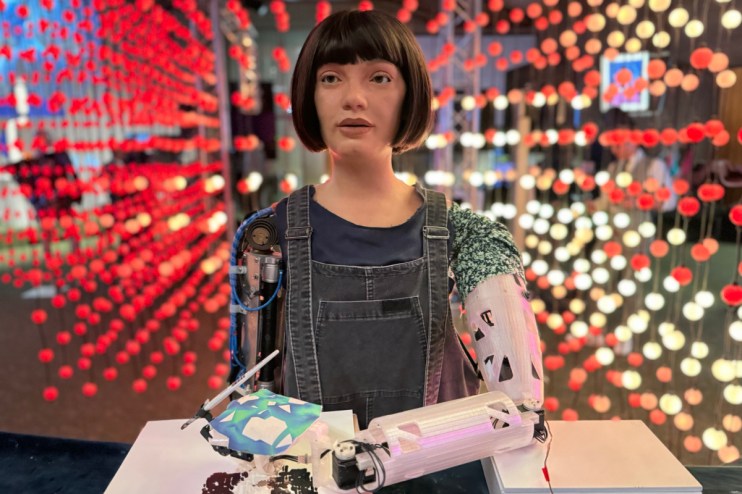
Questions about the nature of creativity and the purpose of art have been most prominently raised by Ai-Da, described by its creator as the “world’s first ultra-realistic artist robot”. Ai-Da’s eyes are actually cameras which feed visual information into her ‘creativity algorithm’, which interprets the data and maps out how her robotic arm should move. She has painted portraits of Queen Elizabeth II and King Charles III and, most recently, designed her first building.
Ai-Da’s existence is thought-provoking, even if her artwork is not. Aidan Meller, Ai-Da’s creator and a former gallerist, said that Ai-Da’s entire purpose was to pose ethical questions about technology, art, and the wider social networks in which they are placed, just like artists throughout history.
How robots can inspire artists
He says he was inspired to create Ai-Da after his son held up a Lego robot figure. “It was an absolutely incredible moment,” he told me. “As I looked at it, I thought: Could AI be used in a robot that is creative, that is an artist and that critiques and comments on the future of technology?”
Listening to Meller, it was clear that he had experienced the flash of inspiration which we like to think of as the purest expression of human creativity, a momentary insight that feels almost like it has come from outside of ourselves. That feeling, Meller argues, is “entirely replicable in AI”.
“Ai-Da can have that Eureka moment too,” he says. “I really believe that.”
I’m not so sure. In the future, perhaps a ‘conscious’ AI (some researchers say they have spotted early signs of self awareness in language models) could have that kind of experience. But Ai-Da is not conscious. She does not have intentions. Surely that is an insuperable barrier to experiencing the rush of excitement that comes in a moment of inspiration?

But Meller argues consciousness is not a zero-sum game. “The data has human consciousness in it. You cannot extract the ‘human consciousness bit’ from the ‘machine bit’. It just doesn’t work,” he tells me. “We are absolutely fusing with the machine.”
Whether or not Ai-Da herself has any intentions, a lot of human intention has clearly gone into creating her. Around 30 people were involved in constructing different parts of Ai-Da across four different universities. So who is Ai-Da really? A creative robot or a collective achievement?
“We are absolutely embedded within a structure we are creating for the future, which it is going to be harder and harder to disentangle ourselves from,” Meller says. Perhaps it is up to the artists to question if this is the future we want…