Skip to content
CityAM
Main navigation
  • News
    • News
      • Latest Business News
      • Economics
      • Politics
      • Tech
      • Banking
      • FTSE 100 Live
      • Retail
      • Insurance
      • Legal
      • Property
      • Transport
      • Markets
    • From our partners
      • AON
      • Bayes Business School
      • Canada BIDs
      • Central London Alliance CIC
      • Destination City
      • Halkin
      • Olympia
      • Inside Saudi
      • Tottenham Hotspur Stadium
      • Santander X
      • YEAR SIX Dividend
    • Featured

      Fifpro accused of leaving footballers ‘in the cold’ by doing deal with Fifa

      Business professionals in a conference room discussing strategies, with a presentation screen displaying key business metr...

      Submit a story

      Tell us your story.

      Submit
  • Opinion
  • Sport
    • Latest Sports News
      • Sport
      • Sport Business
    • From our partners
      • The Morning Briefing: SBS x CityAM
      • Aramco Team Series
      • LIV Golf
    • Featured

      Fifpro accused of leaving footballers ‘in the cold’ by doing deal with Fifa

      Business professionals in a conference room discussing strategies, with a presentation screen displaying key business metr...

      Submit a story

      Tell us your story.

      Submit
  • Life&Style
    • Life&Style
      • Life&Style
      • Toast the City Awards
      • The Magazine
      • Travel
      • Culture
      • Motoring
      • Wellness
      • The RED BULLETiN
      • Do it with Shared Ownership
      • Media Speak Hub
    • Featured

      The best places to eat sandwiches in Lisbon, from bifanas to pregos

      Bifana do Afonsos famous bifana sandwich showcasing tender pork in a freshly baked roll with savory sauce.

      Submit a story

      Tell us your story.

      Submit
  • Investec
  • Events
  • Latest Paper
What is City Talk? City Talk allows marketers to connect directly with our audience by publishing content on cityam.ca
Thursday 20 October 2022 11:24 am  |  Updated:  Thursday 20 October 2022 3:37 pm

Demand destruction? Two reasons to be sceptical

By: CFA Institute Contributor

Add as a preferred source on Google

Global central banks have made an ‘all-in’ effort to front-load monetary policy tightening to dampen demand. But softer economic data in the eurozone and United States have exacerbated recession fears.

As the growth outlook dims, many anticipate demand destruction to lead to lower inflation. That is, tighter monetary policy and the associated higher funding costs will cut into demand and offset the supply shortages resulting from geopolitical instability and supply-chain disruptions. This view hinges on the belief that inflation outcomes are largely driven by central bank policies.

However, what US Federal Reserve chairman Jerome Powell in 2019 described as ‘muted’ inflation in previous years, especially during the 2014 to 2016 oil-price crash, has demonstrated inflation’s insensitivity to demand-side policies. Even the European Central Bank (ECB)’s quantitative easing (QE) in 2015 failed to stoke demand in a way that reduced excess supply.

The Fed’s dovish policy stance in the decade before the pandemic pushed the Atlanta Fed’s Wu-Xia Shadow Federal Funds Rate below zero multiple times. Yet the Fed’s preferred price measure – personal consumption expenditures (PCE) – was less responsive to such policy shifts than to the end of the Cold War or China’s entry into the World Trade Organisation (WTO) in 2001, among other catalysts.


Personal Consumption Expenditures vs. Shadow Federal Funds Rate
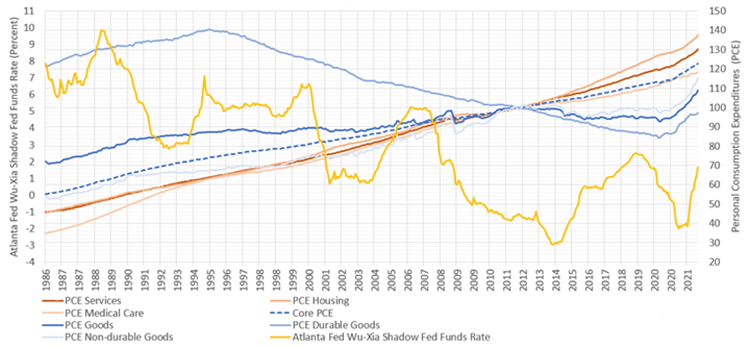
Sources: Federal Reserve Bank of Atlanta, US Department of Commerce, Kekselias, Inc.

Similarly, recent quantitative tightening and rate hikes have not created enough demand destruction to counteract geopolitics-related commodity scarcity. Instead of following central bank policy over the past two decades, inflation largely co-moved with commodity prices, or both demand and supply-side factors.


Eurozone, US, and UK Inflation vs. Commodity Index
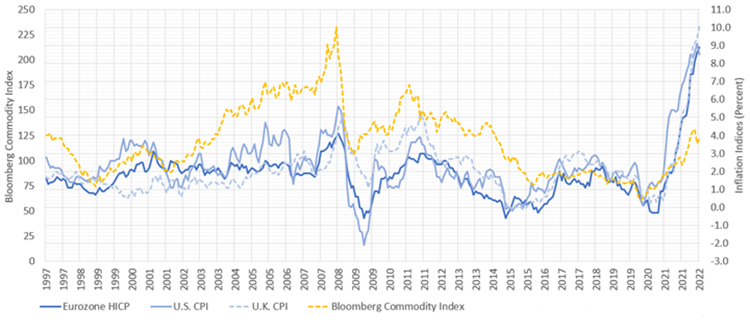
Sources: Eurostat, UK Office for National Statistics, US Federal Reserve, Bloomberg, LP, Kekselias, Inc.

This casts doubts on the ‘rates-determine-activities-determine-inflation’ framework and suggests that domestic monetary policy cannot lift or dampen inflation on its own. Other factors must come into play.

1. Fiscal Spending = Higher Demand

Given QE’s long and variable trickle-down effect, pandemic-era policies sought to counter the demand shortfall by expanding balance sheets and through fiscal stimulus, or printing money and mailing cheques directly to households. This drastically decreased the transmission time between central bank easing and realised inflation. The deployment of ‘helicopter money’ rapidly revived demand.

As pandemic disruptions eased, the anticipated fiscal tightening never materialised. Instead, fiscal-monetary cooperation became the norm and cash payments a regular policy tool. Following its Eat Out to Help Out Scheme, for example, the UK government in May this year announced a £15 billion package to send £1,200 support payments to millions of households. As UK energy prices spiked, Liz Truss, the UK prime minister, proposed an emergency fiscal spending package to ease the public’s financial stress.

Read more

The world can’t keep consuming more than it produces

FTSE 100 stocks rise as Brent crude oil prices jump 1.8% to $104.98 amid Strait of Hormuz tensions and Trumps Iran stance

On the other side of the Atlantic, many US states have announced stimulus payments to soften the pain of high inflation, and president Joe Biden has introduced a student loan relief programme.
The lesson is clear: central banks are no longer the only game in town when it comes to economic stimulus.

2. Geopolitical Events = Supply Disruptions

As multinationals regionalise, near-shore and re-shore supply chains and prioritise resiliency and redundancy over cost-optimisation, energy scarcity in the eurozone has created new disruptions. German chemical production is set to fall in 2022, which could export inflation abroad.

As geopolitical instability contributes to domestic economic challenges and more fiscal stimulus is deployed, inflation may be much less responsive to traditional monetary drivers. Under such circumstances, a rigid framework equating tight monetary policy and high prices with demand destruction and disinflation will no longer be operable.

For investors calibrating portfolio risks, such conditions may offset the disinflationary pressures of slowing growth.


If you liked this post, don’t forget to subscribe to the Enterprising Investor.


By Victor Xing, founder and portfolio manager of Kekselias, Inc., and a former fixed-income trading analyst at Capital Group Companies with a focus on monetary policy, inflation-linked bonds, and interest rates markets.

All posts are the opinion of the author. As such, they should not be construed as investment advice, nor do the opinions expressed necessarily reflect the views of CFA Institute or the author’s employer.


Image credit: ©Getty Images / desperado

Read more

KBRA Releases Research – Sovereign Bond Supply Meets a More Demanding Market

Share this article

  • Facebook
  • X
  • LinkedIn
  • WhatsApp
  • Email

Similarly tagged content:

Sections

  • Markets & Economics
  • News

Categories

  • Business
  • Economics
  • Money

Related Topics

  • supply

Trending Articles

  • London Tech Week sums up everything wrong with UK tech

  • Inflation expectations at record high in interest rates signal

  • KPMG’s Summer Friday half-day rollback signals deeper woes for Big Four giants

  • UK economy falters as deeper damage to growth to come

  • New Gluten-Free Bread Binder Simplifies the Recipe — and Boosts Bread Quality

More from CityAM

  • The world can’t keep consuming more than it produces

    Opinion
    FTSE 100 stocks rise as Brent crude oil prices jump 1.8% to $104.98 amid Strait of Hormuz tensions and Trumps Iran stance
  • KBRA Releases Research – Sovereign Bond Supply Meets a More Demanding Market

    Business Wire
  • London house prices fall as Bank of England rate hikes loom over mortgage market 

    Property
    Housing delivery in London is in a major crisis
  • UK carbon markets stand to get an AI boost

    Opinion
    AWS data centre exterior with modern architecture and advanced infrastructure in a business news context
  • Reeves’ summer of fun won’t deliver growth

    Opinion
    Keir Starmer and Rachel Reeves discuss the Great British Summer Savings scheme at a press conference podium with banners b...
  • Bank of England’s Bailey: Interest rates hike may not be needed

    Economics
    Andrew Bailey, Governor of the Bank of England, used his speech to stress the importance of effective regulation. Credit: Henry Nicholls/PA Wire
  • Inflation, not Andy Burnham, is the culprit behind high Gilt yields

    Opinion
    Burnham smiling broadly at a community event, surrounded by enthusiastic supporters, conveying a sense of positivity and u...
  • Platinum prices soar amid supply deficit and AI demand 

    Investing
    Glencore floated on the London Stock Exchange in 2011 and is one of the largest members of the FTSE 100.
  • Terms & Conditions
  • Privacy Policy
  • Cookie Policy
  • News
  • Markets & Economics
  • Politics
  • Opinion
  • Life&Style
  • Personal Finance

Follow us for breaking news and latest updates

  • Facebook
  • X
  • Instagram
  • LinkedIn
Copyright 2026 CityAM Limited