On this day: The resignation of Margaret Thatcher

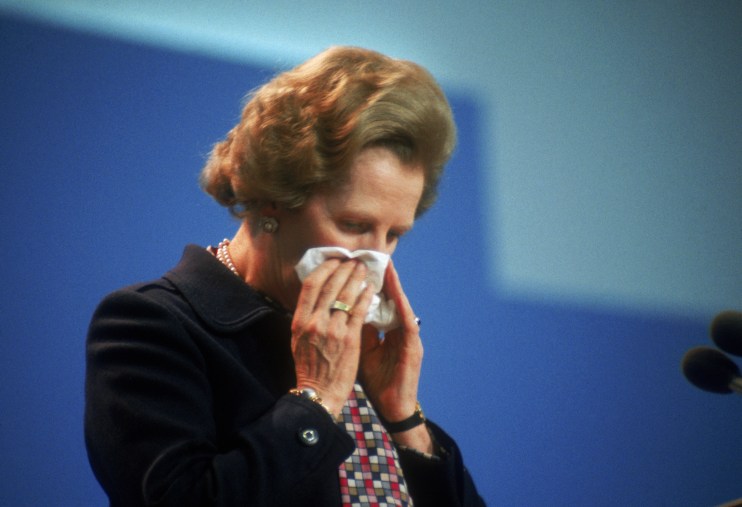
On 28 November 1990, Margaret Thatcher left Downing Street for the last time, leaving the United Kingdom in a very,very much better state than when she came there, writes Eliot Wilson
I doubt I am alone in remembering the day clearly, though I had only recently turned 13. Margaret Thatcher gave a short and emotional speech outside Number 10 Downing Street, then was driven to Buckingham Palace for an audience with Queen Elizabeth II. She tendered her resignation as Prime Minister, and 15 minutes later, John Major arrived to be appointed her successor.
Thatcher had been Prime Minister for more than 11 years. Asked about the prospect of retirement by the BBC’s John Cole in 1987, she had replied “I hope to go on and on”, and her opponents and some of her colleagues began to fear she meant it. Her supporters will say – with accuracy – that after her election to Parliament for Finchley in 1959 Thatcher never lost an election. So how had it come to this tearful, unwilling departure?
Trouble had been growing in the Conservative Party for at least two years. A new local government finance framework had been introduced in Scotland in 1989 then in England and Wales in 1990 to replace domestic rates. The Community Charge was a fixed amount per taxpayer; it was violently unpopular and seen as unfair, quickly dubbed the “poll tax” after the hated measure which had partly provoked the Peasants’ Revolt of 1381.
The Prime Minister was increasingly out of step with some senior colleagues, especially on Europe. Ahead of a European Council meeting in June 1989, the Chancellor, Nigel Lawson, and the foreign secretary, Sir Geoffrey Howe, had demanded she set a date for joining the European Exchange Rate Mechanism. If she refused they would both resign. She avoided committing to a date but made sufficiently positive noises in public to placate them.
Privately Thatcher was incandescent. A month later she shuffled a very unwilling Howe from the Foreign Office to be leader of the House of Commons. In October, having clashed with Thatcher’s economics adviser Sir Alan Walters, Lawson resigned. John Major, having replaced Howe as Foreign Secretary, now became Chancellor.
Geoffrey Howe was a mild-mannered, stoic man who had served Thatcher in opposition and government from the beginning in 1975. The Prime Minister found him increasingly annoying, however, and made no effort to hide it. On 1 November 1990, after nearly 16 years, Howe’s patience snapped and he resigned. Thatcher had weathered ministerial departures before; then, a fortnight later, Howe gave his resignation speech in the House of Commons. It was devastating.
Howe’s tone was quiet and measured, almost enough to distract from the speech’s content – almost. He described Thatcher’s increasingly Eurosceptic tone as “background noise”, warning that the Chancellor and the governor of the Bank of England risked being undermined by some “casual comment or impulsive answer”.
“It is rather like sending your opening batsmen to the crease only for them to find, the moment the first balls are bowled, that their bats have been broken before the game by the team captain.”
He had seen no alternative to resignation. Then he delivered the coup de grâce.
“I have done what I believe to be right for my party and my country. The time has come for others to consider their own response to the tragic conflict of loyalties with which I have myself wrestled for perhaps too long.”
This was an invitation to regicide. Now all attention turned to Michael Heseltine.
The former Defence Secretary had been a brooding presence since his resignation over the Westland affair in 1986. He had avoided publicly disloyalty and had a deft media manner and commanding presence. The day after Howe’s speech, Heseltine announced his candidacy for the leadership.
It is a familiar story. On the first ballot on 20 November, Thatcher led Heseltine by 204 to 152, four votes short of the 15 per cent margin needed to win outright. Returning to London from a summit at Fontainebleau, she declared “I fight on, I fight to win”. But some of her supporters were acutely anxious that Heseltine now had momentum, needing only 27 MPs to switch sides to become leader. Following the disastrous advice of her campaign manager, the drink-sodden and depressed Sir Peter Morrison, she spoke to the Cabinet one by one to gauge their support. Almost all gave the same message: they would support her, but she would lose.
It was over
It was over. To fight on was to risk opening the door to Heseltine, something Thatcherites were determined to avoid. On 22 November, Thatcher reluctantly withdrew her candidacy. She gave her backing to John Major, and the Foreign Secretary, Douglas Hurd, also entered the lists. The second ballot on 27 November was decisive: Major won 185 votes, Heseltine 131, Hurd 56. Heseltine and Hurd withdrew within minutes.
Why did the Conservative Party unseat a premier who had led them to three election victories on the trot? The simplest answer is that MPs concluded she would not succeed a fourth time. Labour had led the opinion polls since May 1989, and the weekend after Howe’s resignation had a 21-point margin. Unseating the PM might be a gamble, but doing nothing seemed to guarantee defeat.
Thatcher was not young, having recently turned 65. With Howe’s departure there was no-one left from her first Cabinet of 1979, and she dwarfed her colleagues. But she was dogmatic, impatient and, in her own mind, irreplaceable. Dauphins had come and gone – Parkinson, Tebbit, Moore – and support for Major was tepid.
She had seen off two Labour leaders, beaten overmighty trades unions and slashed days lost to strikes, curbed runaway inflation, revolutionised the British economy and stood shoulder-to-shoulder with a like-minded US president to see the Cold War end. Not everyone had prospered, inequality had widened and unemployment remained stubbornly high.
But if no army can withstand the strength of an idea whose time has come, no leader can prolong that time indefinitely. Conservative MPs wanted a new approach, although 204 of the total 372 had voted for Thatcher to carry on. Potential defeat in 1991 or 1992 focused minds but represented something deeper. It was simply time for a change.
Thatcher’s husband Denis had tried unsuccessfully to persuade her to step down in 1989, after a decade as Prime Minister. In truth, it is unlikely she would ever have left willingly. There would always be work still to do. Many saw ingratitude and betrayal in her downfall, but she would have to be removed by Conservative MPs or the electorate. So it proved 35 years ago today.
“We’re leaving Downing Street for the last time after 11 and a half wonderful years, and we’re very happy that we leave the United Kingdom in a very, very much better state than when we came here.
Eliot Wilson is a writer