
The maths of why growth companies are beating value


One of the side effects of low interest rates is that, because of the way that companies are valued, investors place a higher value on companies (and investment projects) which have a low probability, high payoff, a long time in the future.
This helps explain why investors have been prepared to pay up for loss-making companies.
We can show why this makes perfect sense mathematically, using a (relatively) simple example. There is a bit of maths involved but I’ve tried to keep it as simple as possible to make it easier to follow.
Boring Reliable Inc.
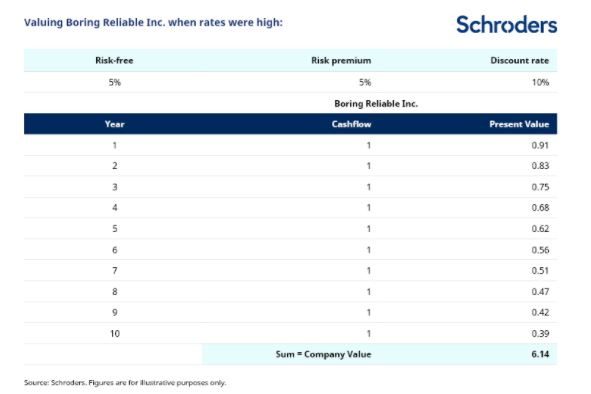
Consider a fictitious company, Boring Reliable Inc. It pays out $1 of cash-per-share to equity holders each year for the next 10 years. For simplicity, I’ve assumed this stays constant over time and that it has no other residual value. However, the broad principles and conclusions would remain the same if we used more realistic assumptions.
The value of this company today can be calculated as the present value of these cash flows. i.e. how much is $1 in 10 years time worth today? This is the maths part…
We use a “discount rate” to work this out, which is the sum of two factors. Firstly the “risk-free rate” of the time – this is normally equal to the interest paid on an investment considered extremely safe, such as a 3-month US government bond. This is added to a “risk premium”, which is the difference between the expected rate of return from an asset and the risk free rate.
Discover more:
– Learn: Would a Biden presidency hurt stock markets?
– Read: What’s driving stock market returns?
– Watch: Is Big Tech under threat?
For the purposes of this example, we have assumed a risk premium of 5%, but our broad conclusions would be the same if we used a different figure. The table below shows how this works out, if we used a risk-free rate of around 5%. This is similar to where they were before the financial crisis hit, hard as it might be to imagine today, when the risk free rate is around 0.70%!
The present value of these cash flows is the value of the company today: $6.14.
Moonshot Inc.
Now consider a racier (also fictional) company, Moonshot Inc. It is expected to generate no cash whatsoever for the next nine years but then hit gold in year ten, with a bumper payout for investors. We can work out how big this payout needs to be for the two companies to have the same present value. This turns out to be $15.94:
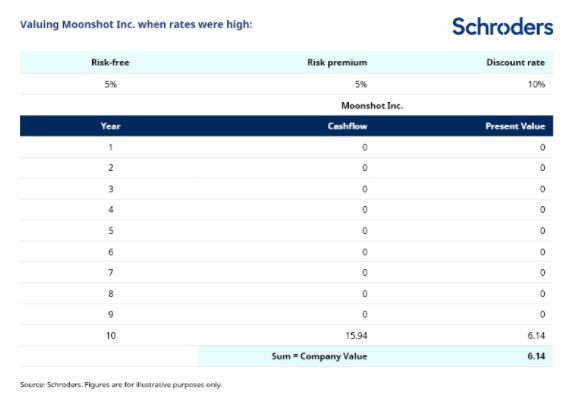
So if you can transport yourself back to 2007, Boring Reliable Inc. and Moonshot Inc. would have been worth the same. What about today?
The impact of lower interest rates
To keep the numbers simple, let’s use a risk-free rate of 1% to reflect today’s environment. If you used 0% or a negative number it would simply result in a more extreme version of our results. The most important point is that it is much lower than the 5% used previously.
The table below shows how the value of each company changes under these new conditions. We have kept all other assumptions the same, for simplicity.
Both companies are now worth more, as the lower risk free rate results in a higher present value for future cash flows – even though those cash flows are identical to previously. In other words, for a given level of earnings or cash flow, lower interest rates translate into a higher valuation.
This is one reason why most measures of stock market valuations appear pretty expensive when compared with historical experience. Rather than being surprising, this is what you should expect to see!
Secondly, Moonshot Inc.’s value has shot up by much more than Boring Reliable Inc. : a 45% gain compared with only 20%. This is because the present value of more distant cash flows is much more sensitive to interest rates than those in the near term. Because all of Moonshot Inc.’s value is derived from a single cash flow, far off into the future, its overall value is much more sensitive to the fall in rates.
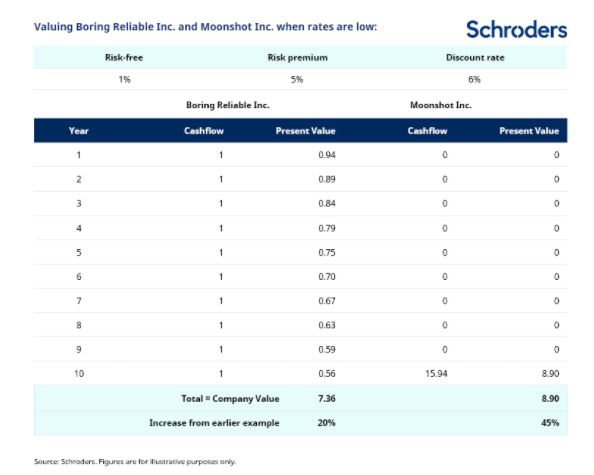
This is nothing to do with whether Moonshot’s prospects have improved relative to Boring Reliable. Their prospects are the same as before. But their values are dramatically different. A version of this is what has been playing out in markets over the past decade. Growth companies, by definition, are expected to grow faster than other companies. In other words, their earnings in 10 years time are expected to be a lot higher than they are at present. This means the present value of those earnings is highly sensitive to changes in interest rates – like Moonshot’s.
In contrast, value stocks have lower growth expectations, so are more like Boring Reliable – they receive less of a benefit from falling rates.
When considered in this way, the outperformance of growth over value in the past decade can be partly explained by maths – it is a direct consequence of lower interest rates (among other things not covered in this article, such as changes in relative growth prospects).
Of course, the reverse is also true. In the example above, Moonshot would fall roughly twice as much as Boring Reliable for a given rise in interest rates. Even a small rise in rates could swing the tables back in value’s favour.
One other important consideration is that a lot can happen in 10 years. Although Moonshot may be forecast to earn $15.94 at that time, there can be no certainties. In contrast, Boring Reliable is forecast to start generating cash immediately. There is less hope baked into its valuation. Followers of growth and value stocks would be wise to bear this in mind.
The value of investments and the income from them may go down as well as up and investors may not get back the amounts originally invested.
This information is not an offer, solicitation or recommendation or to adopt any investment strategy. The forecasts included are not guaranteed
Important Information: This communication is marketing material. The views and opinions contained herein are those of the author(s) on this page, and may not necessarily represent views expressed or reflected in other Schroders communications, strategies or funds. This material is intended to be for information purposes only and is not intended as promotional material in any respect. The material is not intended as an offer or solicitation for the purchase or sale of any financial instrument. It is not intended to provide and should not be relied on for accounting, legal or tax advice, or investment recommendations. Reliance should not be placed on the views and information in this document when taking individual investment and/or strategic decisions. Past performance is not a reliable indicator of future results. The value of an investment can go down as well as up and is not guaranteed. All investments involve risks including the risk of possible loss of principal. Information herein is believed to be reliable but Schroders does not warrant its completeness or accuracy. Some information quoted was obtained from external sources we consider to be reliable. No responsibility can be accepted for errors of fact obtained from third parties, and this data may change with market conditions. This does not exclude any duty or liability that Schroders has to its customers under any regulatory system. Regions/ sectors shown for illustrative purposes only and should not be viewed as a recommendation to buy/sell. The opinions in this material include some forecasted views. We believe we are basing our expectations and beliefs on reasonable assumptions within the bounds of what we currently know. However, there is no guarantee than any forecasts or opinions will be realised. These views and opinions may change. To the extent that you are in North America, this content is issued by Schroder Investment Management North America Inc., an indirect wholly owned subsidiary of Schroders plc and SEC registered adviser providing asset management products and services to clients in the US and Canada. For all other users, this content is issued by Schroder Investment Management Limited, 1 London Wall Place, London EC2Y 5AU. Registered No. 1893220 England. Authorised and regulated by the Financial Conduct Authority.