Trash talk: Recycling boss Bruce Bratley on why we need to talk about rubbish

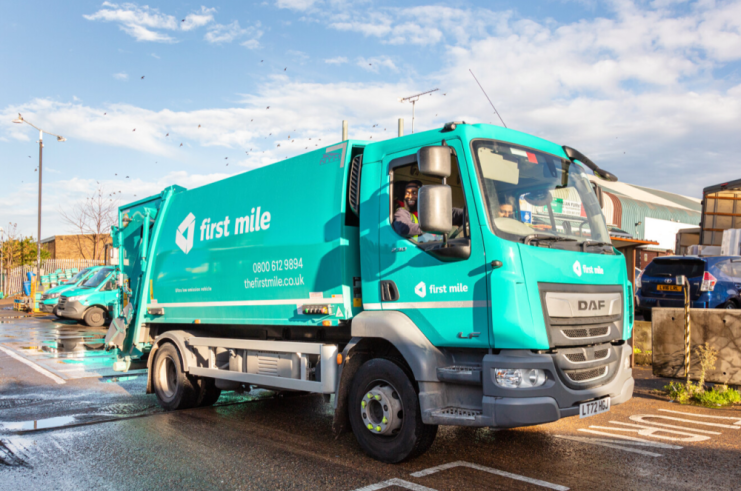
Waste disposal can be revolutionary, as First Mile boss Bruce Bratley tells Lucy Kenningham
For the most part, people don’t want to talk trash. But at the rate we’re throwing stuff away, we can no longer afford not to. The world emitted 2bn tonnes of solid waste in 2016 – this startling figure will rise to 3.3bn in 2050. As the UK started running out of space, we developed the nasty habit of exporting our trash to developing countries in what Franklin Wallis terms ‘toxic colonialism’. Whilst this has started to be reported upon, as a nation we still export 60 percent of our plastic to other countries. Most of it goes to Turkey, where it gets incinerated in dumps causing “irreversible and shocking” environmental impact.
“I’ve always been very passionate about the environment,” Bruce Bratley, chief executive of waste management firm First Mile, says when I meet him at his office near Oxford Street. “I have never been to a protest or a campaign. Hats off to campaigners. And environmentalists, they do a lot of good. But I’ve always been trying to get the system to change from within.”
When Bratley founded waste management firm First Mile in 2004 to “revolutionise” the waste disposal industry, “most businesses’ idea of reducing their impact was actually just exporting it to a developing country”, he says, which “isn’t great, because we may have reduced our CO2 impact, but actually, we’ve just shut down a UK factory then opened it up in Vietnam or somewhere else”.
Not the waste disposed of by First Mile, which offers zero-to-landfill waste disposal – meaning none of the waste they get rid of ends up in landfill. Anything that can’t be recycled goes to a waste-to-energy facility where it’s turned into energy to power homes. The firm’s clients include Pret a Manger, Gails and Caffè Nero which all pay Bratley and co to collect and dispose of their waste in a sustainable way. First Mile is more affordable, it claims, and reliable than the council. Altogether, they have 30,000 customers.
One of First Mile’s more innovative services is its rubbish bags with QR codes on them. This might sound ridiculous – but it isn’t. Often, when you throw something out you also throw away your responsibility. Not with QR-coded bin bags, which send an alert to a company if a bin bag is contaminated with the wrong type of material. “Our customers actually want this,” he tells me. “It gives them the authority to instruct its employees better.” Another service offered by First Mile helps companies to evolve their packaging to improve sustainability. First Mile can advise them on which materials to use for a newly modelled sandwich box, for example.
Bratley is an unusual CEO. For one thing, he wants companies who use First Mile to ultimately reduce the amount of waste they produce in the first place, even if that means using less of his services (and therefore paying him less money). Really? I ask. Does he really want customers to use his services less? “Oh, yeah. It’s total madness. You know, when I talk to friends in business they say why would you want to do that? But it’s because we’re a purpose-led organisation,” he says. He envisions building towards being a company that helps repair and refurbish items, as well as recycle them. Businesses could collect and reuse products with a focus on sustainability and reducing waste. “Our long-term goal is to monetise nothing,” he adds.
‘Capitalism is inherently contradictory’
He’s a vegetarian – “I’m just, like, amazed at how people think that’s weird?” – and also has a doctorate in Marxist Environmentalism. Bratley isn’t a communist (his company makes a profit of £5.5m a year), but as a PhD student he found the framework a helpful lens through which to criticise the status quo. Capitalism is inherently contradictory, he tells me. It destroys its own means of production – humans – by putting them into horrible factories and damaging their health.However, humans are also the means of consumption, therefore capitalism’s fundamental contradiction is that it destroys the very people it relies on.
“And the Neo Marxist or ecological Marxist reading is that there’s actually a political ecology in which you have this paradox, again. We consume nature to manufacture things,to produce things and to make capitalism great. But that in itself is a contradiction, because eventually, when everything’s gone, or everything’s polluted, then that’s the end, which is basically a linear economy,” as Bratley puts it.
“This is the opposite of the circular economy,” he says, “which is a model of production that promotes reducing waste to a minimum, by recycling existing materials and products for as long as possible. It’s this circular system that is the key. If we don’t change things up, the planet will be absolutely fine – it’s humans that will be destroyed.”
A circular economy is what many are calling for. It can be achieved through maintenance, reuse, refurbishment, remanufacture, recycling, and composting. In a report this year, MPs on the environment committee urged the government to aim for all plastic waste to be recycled, reused or composted by 2042 – pleading with ministers to create a more “circular economy” to reduce how much waste the UK produces.
This is what Bratley thinks we should be moving towards. Not everyone seems to know it, but the majority of items we use everyday can in fact be recycled if taken to the right facilities. Bratley talks me through them: glass can be recycled ad infinitum; nearly all plastics can be recycled. It takes just 10 days for a cardboard box to be recycled into a new one. Mixed packaging makes things difficult, but optical sorting exists in plants to help separate materials.
What if people don’t care?
It’s tricky, though. Partly due to lack of public awareness. I mean, what if people don’t care? “I find it extraordinary [that we don’t talk about the environment more],” he says. “We had two years where all we talked about was Covid. If we spent two years only talking about the impact we’re having on the environment, and how stupid we are, then we might actually get some change.”
Whilst last month’s King’s Speech didn’t detail any legislation about recycling, Bratley is positive about the Separation of Waste Act. The primary legislation is in there, we just need the secondary legislation to come through and that includes things like the bottle deposit return scheme.
What would you say to someone who doesn’t feel impassioned to recycle? “As humans, we do really dumb things all the time. Which is sort of why I quite like recycling. Well, I love recycling. This is my job. But recycling is quite benign in terms of, you know, choosing to put the right thing in the right bin. It just seems like a really easy thing to do.”
Bratley says First Mile isn’t interested in working with the most environmentally impactful firms. Instead, he’s “interested in buying legacy waste businesses that aren’t recycling, to deliver more impact”. If you don’t care about the planet, you might at least care about your ESG score. So what can you do if you’re at a company that isn’t disposing of its waste in a sustainable way? Ask awkward questions, he says, straight away.