
Which lockdown habits could last a lifetime?


“Prediction is very difficult, especially about the future.” This cautionary quip, attributed to Nobel Prize winning quantum physicist Niels Bohr, is applicable to anyone making forecasts, and particularly investors at this point in time.
Stock markets will continue to be buffeted by daily newsflow around the pandemic. Successful investing in consumer stocks over the next couple of years, however, will depend on developing a vision of post-pandemic consumption patterns with the help of a clear framework.
Where lifestyle changes are permanent, extrapolating the trends of the past year could well be fruitful. On the flipside, riding a “reversion to the mean” might be the right investment approach for those businesses poised to rebound, once restrictions are eased and where old behaviours could return.
And, of course, avoiding those stocks where the market is wrongly assuming that lockdown dynamics extend long into the future will be crucial. Here are some observations to help navigate the likely dramatic swings in the public health outlook, and within the stock market, that we may experience over the next few months.
Why the effects of the pandemic won’t end overnight
Markets embraced the Pfizer/BioNTech vaccine efficacy announcement on 9 November 2020, with sectors and companies that had suffered most from lockdowns performing particularly well. Oil surged 8.5% and concert promoters rose as much as 24% on the day. Airlines globally embarked on a two day rally of 15%.
The Pfizer/BioNTech news, combined with subsequent announcements from other vaccine developers, marked a massive breakthrough for the public health outlook. However, it has subsequently become clear that there will be no clean break from the pandemic, no single moment when we declare victory and return to the old normal.
New variants that reduce vaccine effectiveness are the clearest obstacle to such a scenario, but there are also issues of vaccine rollout logistics and the duration of immune response (still unknown, for obvious reasons).
It is also difficult to imagine a rapid reintegration of travel between those countries (China, Australia etc.) where Covid-19 has been heavily suppressed and those that are on a path to herd immunity.
Hence the scenario we have to imagine is of a gradual relaxation of restrictions, with occasional setbacks and significant variation between countries.
Discover more from Schroders:
– Learn: What investors can learn from Bill Gates’ climate warning
– Read: How investors can access the UK’s industrial recovery
– Watch: Will 2021 be the time for investors to stop hibernating?
Treat short-term price movements with caution
Consumer spending patterns may be quite erratic in response to the evolving environment. In particular there is likely to be significant pent-up demand for all types of experiences when restrictions are eased.
A surge in travel in the summer of 2021 seems highly probable in countries where vaccine rollouts have reduced the public health risk. This surge in demand will meet reduced capacity and could drive significant price increases for flights and hotel rooms.
Likewise, if people are allowed to socialise more freely then the hospitality trade and all that goes with it (ride sharing, alcoholic beverages etc.) will likely prosper.
A leg-up in spending on experiences could crowd out spending in other areas and therefore the summer months may give a false impression of eventual consumption patterns post pandemic. High savings rates in countries like the US suggest more money to go round overall but there may still be some misleading short-term movements.
The market is likely to react to these moves positively and negatively. As a result it is important for investors to have a clear vision of the long-term direction of spending patterns in order to navigate the months ahead.
Why it’s difficult to form and break habits
The academic literature suggests it can take up to 254 days to form a habit (How are habits formed: Modelling habit formation in the real world. European Journal of Social Psychology. October 2010). Since most consumers have now been dealing with pandemic-related restrictions for at least that long, one might jump to the conclusion then that our new routines are here to stay.
However, there is more to habit than purely repetition over an extended period of time. Psychologists and behavioural experts also talk about a “habit loop”, which has three components – “contextual cue”, the behaviour itself, and the reward (Healthy through habit: Interventions for initiating & maintaining health behavior change. Behavioral Science & Policy).
As the public health situation normalises, key parts of the habit loop will be broken: some of the contextual cues forced by the pandemic (home schooling etc.) will be absent. And, importantly for us, the reward may be more easily achieved via pre-pandemic behaviours.
Much has been written about how the pandemic has accelerated pre-existing trends – particularly digitisation trends like e-commerce, video conferencing, and connected gaming. Other notable changes include increased interest in health and wellbeing, scratch cooking, and investment in people’s homes.
Using the habit framework outlined above, the changes that are most likely to be “sticky” are the ones that bring a reward that can’t easily be replicated once restrictions are eased. The table below outlines our views on what this means for some of the major trends.
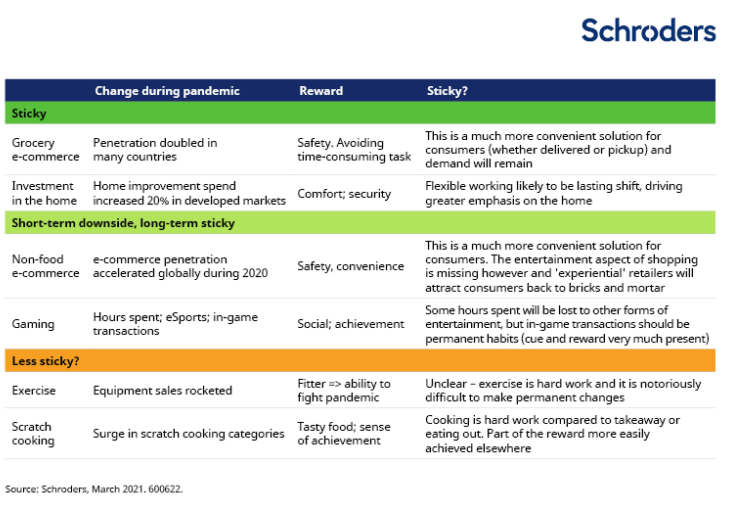
If investors can correctly anticipate what happens to post-pandemic behaviour, it will allow them to build “positive growth gaps” in their forecasts for companies benefiting from these trends. Equally, they’ll be able to avoid ones where the market is wrongly extrapolating ephemeral changes.
It is positive growth gaps which drive share price outperformance. If a company achieves results that are superior to those expected by consensus and those priced in by the market, then that company’s share price is likely to outperform.
The long-term implications of the way we do business
The impact of these trends on revenues is obvious. The biggest rewards, however, will come from identifying those companies which have been able to change the way they do business with a potential lasting positive impact on profitability and returns.
A great example is in sneakers and athletic apparel sector. Brand owners have historically distributed their products through bricks and mortar retailers.
These “legacy retailers” have taken a significant amount of the profits and yet, in many cases, failed to effectively merchandise the product, although there are some notable exceptions.
For years the brand owners have been building their own stores and e-commerce sites, and developed elaborate app “ecosystems” to attract customers from the legacy retailers. While they had made steady progress in this regard, it was an expensive endeavour, which held back profitability.
With Covid-19, many customers found their own way to the brand owners’ websites and apps. With the shift to e-commerce platforms likely to be permanent, we expect to see a step change in profitability and returns.
Sales of running and workout gear may decelerate in 2021 compared to 2020. This, however, is less relevant than the change in the way these companies are now able to do business, or the shift in their “business model”.
On the flip side, the increased penetration of grocery e-commerce is a headache for traditional food retailers. From their point of view, there is no business model superior to having a customer drive to the store, pick their own goods, put them on the checkout conveyor belt (or even better go through self checkout), pack them, and then drive them home.
Any change to this model adds labour and costs them money in a business where profitability is already challenged. This is a key reason why many had dragged their heels in making e-commerce widely available prior to the pandemic.
Unfortunately for them it will be impossible to put the toothpaste back in the tube (so to speak). While some consumers will always prefer to pick their own food (particularly fresh food), the convenience of e-commerce will prove to be a more important reward for most.
Grocers are scrambling to automate as much of the picking process as possible but this requires capital expenditure and has a long lead time. They are also trying to take the delivery cost out of the equation by incentivising “click and collect”, but this will not be the preference of many consumers.
The laws of economics suggest that eventually the incumbents will be able to charge enough to make reasonable returns on e-commerce, but eventually is a long time and in the meantime profitability will be under pressure.
Investors will need to develop a framework to judge how enduring the lifestyle changes seen during the pandemic will be. Then, through modelling their long-term impact on company fundamentals – to identify positive growth gaps – they should make good investments.
Volatility and misleading short-term share price movements lie ahead. These, however, should only increase the opportunity for those with a clear vision to buy the right companies at attractive prices, knowing they are beneficiaries of durable changes in habit.
– For more visit Schroders insights and follow Schroders on twitter.
Important Information: This communication is marketing material. The views and opinions contained herein are those of the author(s) on this page, and may not necessarily represent views expressed or reflected in other Schroders communications, strategies or funds. This material is intended to be for information purposes only and is not intended as promotional material in any respect. The material is not intended as an offer or solicitation for the purchase or sale of any financial instrument. It is not intended to provide and should not be relied on for accounting, legal or tax advice, or investment recommendations. Reliance should not be placed on the views and information in this document when taking individual investment and/or strategic decisions. Past performance is not a reliable indicator of future results. The value of an investment can go down as well as up and is not guaranteed. All investments involve risks including the risk of possible loss of principal. Information herein is believed to be reliable but Schroders does not warrant its completeness or accuracy. Some information quoted was obtained from external sources we consider to be reliable. No responsibility can be accepted for errors of fact obtained from third parties, and this data may change with market conditions. This does not exclude any duty or liability that Schroders has to its customers under any regulatory system. Regions/ sectors shown for illustrative purposes only and should not be viewed as a recommendation to buy/sell. The opinions in this material include some forecasted views. We believe we are basing our expectations and beliefs on reasonable assumptions within the bounds of what we currently know. However, there is no guarantee than any forecasts or opinions will be realised. These views and opinions may change. To the extent that you are in North America, this content is issued by Schroder Investment Management North America Inc., an indirect wholly owned subsidiary of Schroders plc and SEC registered adviser providing asset management products and services to clients in the US and Canada. For all other users, this content is issued by Schroder Investment Management Limited, 1 London Wall Place, London EC2Y 5AU. Registered No. 1893220 England. Authorised and regulated by the Financial Conduct Authority.