Skip to content
CityAM
Main navigation
  • News
    • News
      • Latest Business News
      • Economics
      • Politics
      • Tech
      • Banking
      • FTSE 100 Live
      • Retail
      • Insurance
      • Legal
      • Property
      • Transport
      • Markets
    • From our partners
      • AON
      • Bayes Business School
      • Canada BIDs
      • Central London Alliance CIC
      • Destination City
      • Halkin
      • Olympia
      • Inside Saudi
      • Tottenham Hotspur Stadium
      • Santander X
      • YEAR SIX Dividend
    • Featured

      Fifpro accused of leaving footballers ‘in the cold’ by doing deal with Fifa

      Business professionals in a conference room discussing strategies, with a presentation screen displaying key business metr...

      Submit a story

      Tell us your story.

      Submit
  • Opinion
  • Sport
    • Latest Sports News
      • Sport
      • Sport Business
    • From our partners
      • The Morning Briefing: SBS x CityAM
      • Aramco Team Series
      • LIV Golf
    • Featured

      Fifpro accused of leaving footballers ‘in the cold’ by doing deal with Fifa

      Business professionals in a conference room discussing strategies, with a presentation screen displaying key business metr...

      Submit a story

      Tell us your story.

      Submit
  • Life&Style
    • Life&Style
      • Life&Style
      • Toast the City Awards
      • The Magazine
      • Travel
      • Culture
      • Motoring
      • Wellness
      • The RED BULLETiN
      • Do it with Shared Ownership
      • Media Speak Hub
    • Featured

      The best places to eat sandwiches in Lisbon, from bifanas to pregos

      Bifana do Afonsos famous bifana sandwich showcasing tender pork in a freshly baked roll with savory sauce.

      Submit a story

      Tell us your story.

      Submit
  • Investec
  • Events
  • Latest Paper
Monday 03 November 2014 8:08 pm  |  Updated:  Friday 07 June 2019 3:32 pm

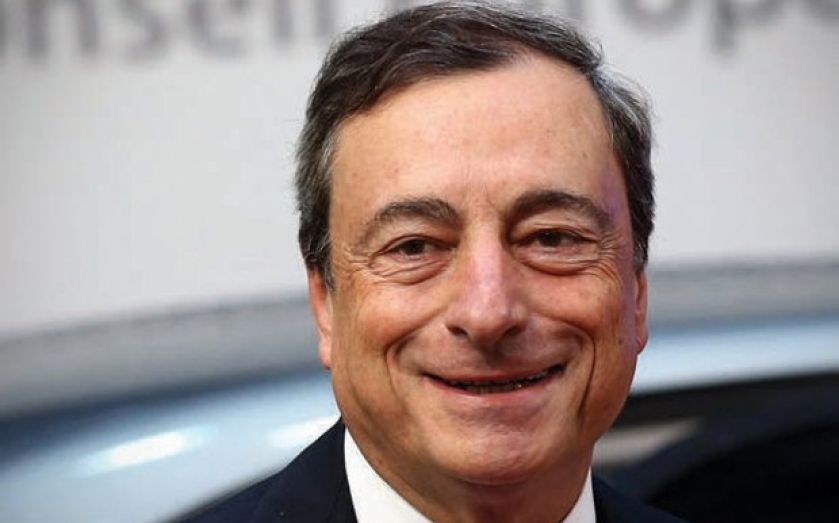
Why Draghi may opt against full QE – CNBC Comment

By: Catherine Boyle

Add as a preferred source on Google

As one major central bank – the US Federal Reserve – closes the quantitative easing door, markets are hoping that another – the European Central Bank (ECB) – will throw it wide open again.

Many economists now expect that ECB president Mario Draghi will usher in a quantitative easing policy, involving buying up countries’ debt, early in the New Year.

There is definitely an air that something needs to be done in the Eurozone. Unemployment remains stubbornly high at 11.5 per cent and inflation, at 0.4 per cent, doesn’t look that far away from the deflation danger zone. Two of the currency bloc’s biggest economies, France and Italy, are going to need extra wriggle room to meet their budgetary targets – and even Germany, the stalwart of recent years, looks less confident than for some time.

Yet is QE that something? The most obvious problem with a quantitative easing programme, particularly when it involves buying up sovereign bonds, is the potential political fallout. How can you make sure that you’re not giving some Eurozone countries an unfair advantage, particularly if they have already been helped out with tens of billions of euros in bailout aid during the financial crisis? No wonder Germany’s anti-euro party, Alternative für Deutschland, is causing Angela Merkel almost as much trouble as Ukip is David Cameron.

And can QE really be that effective? In the UK and US, effectively printing money has helped to reduce credit spreads and, therefore, the cost of borrowing. Yet the Eurozone already has low credit spreads and borrowing rates, after a series of actions by the ECB. The gap between the cost of short and long-term borrowing for Germany, for example, is already much smaller than it was in the US before QE was introduced there. If funding does not seem to be filtering through to the real economy, how could the ECB ensure that, by pumping more money into the system, it reached the right places?

Those in favour of adopting QE would argue that, by spreading the risk around in a way that is allowed under the ECB regulations (as QE appears to be), and in ensuring the survival of the euro project, the region as a whole will be better off, no matter what some Germans may think. And frankly, there doesn’t seem much else left to do to stimulate the region’s recovery.

Whether Draghi chooses to nudge the door open for QE this Thursday or not, his task of steering the Eurozone through its recovery looks trickier than ever.

Share this article

  • Facebook
  • X
  • LinkedIn
  • WhatsApp
  • Email

Similarly tagged content:

Sections

  • News

Categories

  • CityAM Content

Related Topics

  • Mario Draghi
  • People
  • Quantitative easing

Trending Articles

  • London Tech Week sums up everything wrong with UK tech

  • Inflation expectations at record high in interest rates signal

  • KPMG’s Summer Friday half-day rollback signals deeper woes for Big Four giants

  • UK economy falters as deeper damage to growth to come

  • New Gluten-Free Bread Binder Simplifies the Recipe — and Boosts Bread Quality

More from CityAM

  • Bank of England says quantitative easing programme to cost taxpayer £125bn

    Economics
    The Bank of England is expected to hold interest rates at four per cent due to stubbornly high inflation.
  • End quantitative tightening now

    Opinion
    Bank of England headquarters in 2025, showcasing modern architecture and iconic London skyline in the background.
  • Gilt rout sparks calls for Bank of England to slow ‘unusual’ bond sale programme

    Economics
    The Bank of England is expected to go ahead with an interest rate cut despite high inflation.
  • ECB inflation survey points to sharp surge in prices

    Economics
    Annual inflation fell to 1.8 per cent in September, down from 2.2 per cent in August and below the 1.9 per cent expected by economists.
  • Revolut faced orders to fix ‘deficiencies’ in product launches in Europe

    Fintech
    Revolut London office glass facade with prominent R logo reflecting cityscape, highlighting modern fintech design
  • KBRA Releases Research – Sovereign Bond Supply Meets a More Demanding Market

    Business Wire
  • Inflation, not Andy Burnham, is the culprit behind high Gilt yields

    Opinion
    Burnham smiling broadly at a community event, surrounded by enthusiastic supporters, conveying a sense of positivity and u...
  • Northern Trust Asset Management Announces Adaptive Equity Funds

    Business Wire
  • Terms & Conditions
  • Privacy Policy
  • Cookie Policy
  • News
  • Markets & Economics
  • Politics
  • Opinion
  • Life&Style
  • Personal Finance

Follow us for breaking news and latest updates

  • Facebook
  • X
  • Instagram
  • LinkedIn
Copyright 2026 CityAM Limited