Why modern work leaves ancient brains exhausted

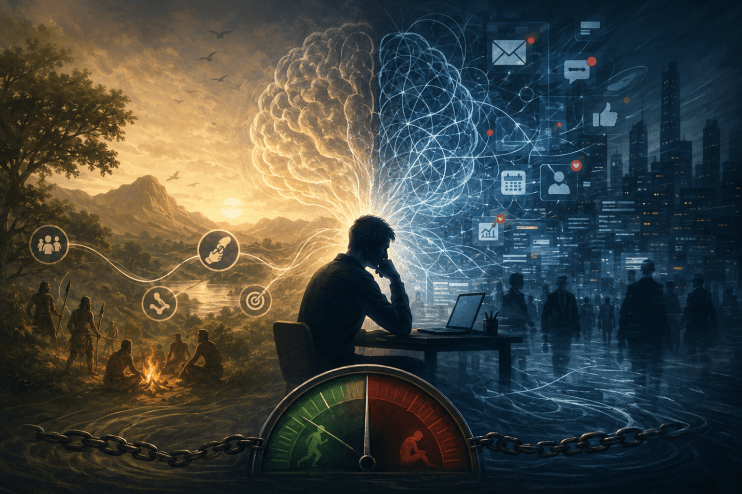
Modern anxiety and exhaustion result from the conflict between our ancient brain machinery, which is optimized for simple, short-term pursuit and reward, and the abstract, distant, and competitive goals of modern life, says Paul Goldsmith
A strange thing has happened in modern life. We have more comfort, knowledge, choice and technology than any previous generation. Yet many people feel more anxious, distracted and dissatisfied than ever.
Someone can spend a whole day answering emails, barely leave their desk, and still feel exhausted. Another can attend meetings, work across multiple projects and end the day oddly demoralised.
This is not simply because modern work is hard. Work has always been hard. Nor is it because we are weak, lazy or uniquely fragile. The deeper problem is that we are trying to run modern lives on ancient brains.
The human brain was not designed from scratch for performance reviews, pension projections, social media metrics or five-year career plans. It is not like software where you can write off tech debt and build a clean new version. We are stuck with brain machinery laid down over millions of years: core control mechanisms optimised for a very different world.
At its most basic level, the brain is a tool for directing action: moving us towards things worth pursuing and away from things that are dangerous or wasteful. Dopamine, often lazily described as the brain’s “pleasure chemical”, is a key part of the machinery of goal pursuit. Critical word: pursuit. Wellbeing does not come only from getting the reward. It comes from the sense of making progress towards a goal we have locked onto, usually one our environment has set for us.
Even Pavlov’s dogs were not built merely to sit in cages and receive food. Brains evolved to pursue rewards, not just have them delivered. This matters beyond the workplace: any system that protects people from hardship but strips away agency, contribution and visible progress can unintentionally deepen misery.
Disengagement is melancholy
But there is another side to this system. When the brain perceives that the effort required is greater than the likely reward, it encourages us to disengage. A feeling that helps induce that disengagement is melancholy. In the right setting, that is useful.
In ancestral environments, this goal-control system worked well. Key goals were physical and social. Exclusion from the group was lethal, so the drive for both validation and status was potent. Goals were often short-term and visible: find food, repair shelter, help the group, gain respect through competence. Contribution was direct, and feedback was fast.
Modern goals are different. They are often abstract, distant and socially constructed: build a successful career, become financially secure, optimise your health, be a good parent, maintain your network, stay informed, keep up, stand out, fit in. These goals may take years to achieve, if they can be achieved at all. Worse, they often conflict with one another.
Meanwhile, comparison has exploded. We no longer measure ourselves against a small group whose abilities and efforts are similar and we observe directly. We compare ourselves with millions. We have a status arms race and winner-takes-all feedback loops. The goals being fed to our brains may be impossible, or so ambiguous that progress is hard to register.
The brain keeps pushing, but the reward signals are weak. If it perceives inadequate progress, it may generate the urge to disengage – but mortgages, ambition, identity and expectation keep us going. The accelerator and brake are locked on together.
A delayed reply, a meeting we were not invited to, a colleague promoted before us, someone else’s higher salary: each can be interpreted by the brain as evidence of failure or exclusion. Our frontal lobes then imagine, infer, rehearse and ruminate.
The result is that a sentence in an email can trigger a bodily response designed for a rustle in the bushes. Cortisol and adrenaline prepare us for action, but the action available is usually to tap a keyboard: ancient physical response systems triggered by a computer screen.
The answer is not to pretend we can return to the Stone Age, or romanticise ancestral life. The point is more practical. We need to adapt our approach around the brain’s operating manual.
Rather than let society play us, we should turn the tables and play the game better. That means combining the grit required to compete with a clearer understanding of which progress signals are real, which are misleading, and which are traps. It means shaping life around activities that reliably deliver wellbeing.
Most of all, it means changing the question. When we feel exhausted, anxious or low, we tend to ask: what is wrong with me? Often the better question is: what is my brain trying to do, and why is this environment pushing it out of range?
Our brains were not built for happiness in the modern sense. They were built for persistence in service of our genes, with happiness as one of the tools they use.
That is not an argument against progress. It is an argument for reading the instruction manual and designing progress around the brains we actually have.
Paul Goldsmith is a neurologist, neuroscientist, visiting Professor at Imperial College and author of The Evolving Brain: How to Thrive in a World We Weren’t Made For