Will western brands return to pariah state Russia?


It was the sight that heralded a new geopolitical era.
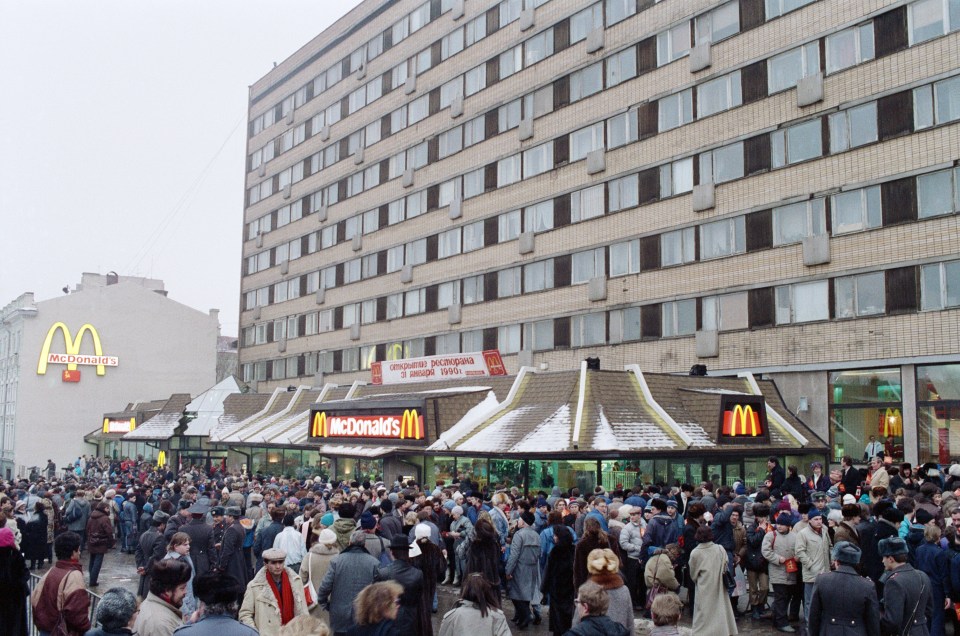
Hundreds of Russian punters standing in a disorderly queue and braving the bitter Moscow air to sample their first bite of the latest big import from America.
The iron curtain – having been chipped away slowly for years – had fully fallen just two months earlier, when thousands of East Berlinners hungry for a taste of freedom razed the Berlin Wall to the ground.
Now, a more dispassionate group of Muscovites were jostling and inching their way into a snow-capped building adorned in several sets of golden arches for a freedom-signifying taste of a more literal variety.
Russia’s first McDonald’s served a reported 38,000 customers on its opening day in 1990. And far from just breaking the fast food chain’s record for a single service, its popularity shattered a more pervasive myth: that western companies could not be a feted success in the country that for decades had been the nucleus of the world’s largest planned economy.
Over 32 years that followed, not once – the rumour went – was the McDonald’s on Pushkin Square ever empty, as Russian diners developed a penchant for their fix of fatty processed beef and heavily-salted fries.
That was, at least, until March 2022 – a month into Russia’s invasion of Ukraine – when McDonald’s suspended operations in Russia, before announcing a full exit the following May.
The fast food juggernaut was not alone in deciding to leave the pariah state. Since the invasion of Ukraine began, over 1,000 western companies have publicly announced they have exited or curtailed operations in Russia above and beyond their legal obligations through sanctions.
In a bid to maintain their reputations among western customers and policymakers, UK blue chips like WPP, Unilever, and Next have all fully left Russia and its client state Belarus since February 2022, according to the Yale School of Management. Meanwhile others – such as HSBC, Astrazeneca and Smith & Nephew – have retained a presence, but wound down elements or divisions of their trading, like cancelling further investment or annulling future product development.
The corporate exodus has been the largest of its kind in history, and – along with the slew of more formal sanctions – has shaved an estimated five per cent off the Russian economy
But it has come at a cost to the companies themselves. A Reuters analysis puts losses through writedowns, lost revenue and legal wranglings among the departed at $107bn (£85bn), with oil major BP forced to take a £20bn haircut when it offloaded its 19 per cent stake in the state-owned Russian energy giant Rosneft.
With the new Trump administration anxious to mediate a peace settlement, the pendulum, however, could soon swing back. And the spectre of a Russian economy no longer at war with Ukraine, and to which western companies could return is – if not among multinational boards’ most pressing decisions – back on their horizon.
During last month’s curtain-raising talks between US and Russian officials, Marco Rubio, the US secretary of state, spoke of the “extraordinary opportunities” – both economic and geopolitical – that lay on the other side of a successful settlement. And for his part, Donald Trump wrote on Truth Social last week that he had engaged in “serious discussions [about] major Economic Development (sic) transactions which will take place between the United States and Russia”.
Meanwhile, head of the state-run Russian Direct Investment Fund told state media that he expects some US firms back as soon as the second quarter, suggesting Russia appears a willing participant.
But despite the pronouncements of key figures in the US administration and Putin acolytes, analysts – particularly those with a UK and European bent – do not believe the floodgates of free trade will re-open any time soon; especially if Ukraine continues to be sidelined.
“If Ukraine are not a core component on the peace deal, it’s a lot less likely that organisations will go back to Russia,” David Duffy, chair of The Corporate Governance Institute, told CityAM. “And if they, do the risks they may face are significant. I can’t see many European firms going into Russia in the hope it’s all going to work out.”

“It doesn’t feel a realistic option at this point,” says Luke Sullivan, a director at Headland. Sullivan, who was also Keir Starmer’s political director between 2021 and 2024, pointed to the new raft of sanctions announced by David Lammy and European Commission to mark the third anniversary of fighting as indicating just how far Europe is from any economic rapprochement with Russia.
The clear blue water that has emerged between the Europe and US foreign policy – cemented by vice president JD Vance’s inflammatory speech at last month’s Munich Security Conference – will also be playing on firms’ minds.
“Evaluating country and regional considerations is essential,” says Michael Hartt, a senior partner in Fleishmanhillard’s international affairs practice. “A peace deal between the United States and Russia may not be received positively across Europe, so European companies and multinationals with a large European presence will need to carefully manage a transatlantic divergence of opinion.”
This, Duffy says, means a situation whereby US firms – encouraged by an administration keen to burnish its negotiating prowess – are earlier returners than their European competitors is likely. Indeed, he adds, some might even “be forced to go back in as part of some deal”.
There is a scenario in which this could leave British and European firms at a disadvantage. US competitors stealing a march on their recalcitrant UK-headquartered counterparts and mopping up Russian demand for household name brands could, in theory, leave little slack for slower-moving competitors on which to capitalise.
But Hartt does not believe such a series of events is likely. Indeed ‘going early’ – in his eyes – would leave eager brands vulnerable to a reputational backlash. “There’s little obvious upside on being a first mover,” he says. “They should anticipate scrutiny and pressure from advocacy groups and people like Jeffrey Sonnenfeld at Yale University, who tracked commitments and operational changes after the war began.”
There are, of course, other hurdles that companies weighing up a return can expect to encounter. Bill Browder – the arch Kremlin critic dubbed ‘Putin’s number one enemy’ – previously told CityAM that any western firms weighing up whether to return “deserve to lose all their money”. And there is nothing to suggest that in this new geopolitical reality the Russian state is any less likely to seize assets or dishonour agreements than it was before.
BP – for example – had its Moscow office raided by bailiffs in 2011 in a move the firm said had “no legitimate grounds”. These perturbing effects will only be amplified, says the Tony Blair Institute’s Dan Sleat, by the fact they would find a “deeply changed Russia”, with double-digit inflation and 21 per cent interest rates on any return they make. “A combination of factors like increased defence spending, sanctions and brain drain are causing real pressures on the Russian economy,” he adds.

But a hollowed out economy will not be the only change.
Were one to visit the site of the former flagship McDonald’s on Pushkin Square today, only an eagle-eyed observer would – on first glance at least – notice much had changed. The lights are still on. The kitchen is a hive of activity. And the same self-service screens used by the fast food giant across the world remain standing.
Punters can also still order familiar-looking items. Barring subtle name differences, the ‘Big Hit Burger’, a ‘Double Fish Burger’ and ‘Giant Fries’ all appear as they would at a McDonald’s in London or New York.
But in the place of the iconic ‘Golden Arch’ logos that were once littered throughout the restaurant are a different-looking M-like replacement. One that represents ‘Vkusno i tochka’ – or ‘Simply Delicious’ – the Russian copycat brand that moved into McDonald’s sites after it beat a hasty exit.
The Pushkin Square Vkusno i tochka’s June 2022 opening attracted similarly excitable queues to that of its forebear 32 years earlier, suggesting Russians’ taste for fast food and other western-influenced goods remains undimmed by a change of name.
But whether, after three years of anti-western propaganda, they have the appetite or demand for a return of the companies that spawned these goods remains a supersized question.