On this day: The fall of Carillion

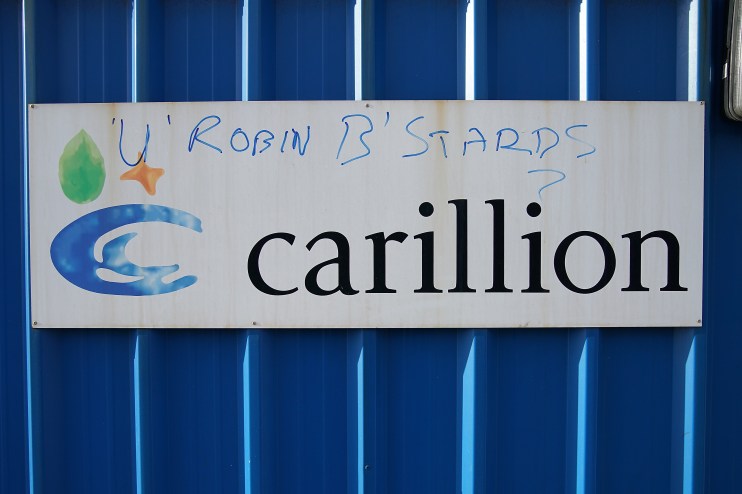
On this day 2018 Carillion, the construction giant, ran out of road
Tarmac. It is easy to forget that the word we unthinkingly use for the everyday road material began life as a trademark, a mixture of coal tar and macadam aggregate which in 1903 launched a company. By the 1990s, Tarmac Group was a construction giant with an annual turnover of £3bn. In the preceding decades, the Wolverhampton-based firm had bought up house-building companies, and that sector came to account for more than half its profits.
Then the worldwide recession of late 1990 hit. The spike in oil prices after Saddam Hussein’s invasion of Kuwait, restrictive monetary policy and a sharp fall in business and consumer confidence led to economic contraction. A decline in house-building and overinvestment in land pummelled Tarmac, its chairman and chief executive, Sir Eric Pountain, was ousted and the group began to restructure and downsize.
In July 1999 Tarmac Group was broken up: the heavy building materials concern retained the Tarmac name, while Tarmac Construction and Tarmac Professional Services were brought together and relaunched as Carillion.
There was something symbolic about the transition from the genericised brand name “Tarmac” to “Carillion”, a name devised by image consultants Enterprise IG to give the new company a fresh and separate identity. It was also faintly hollow and elusive, a mild corruption of “carillon”, a peal of bells.
There was nothing hollow about Carillion’s initial performance. It spent its first years on an acquisition spree: in 2001, the 51 per cent of GT Rail Maintenance it did not already own, creating Carillion Rail; in 2002, Citex Management Services; Planned Maintenance Group in 2005; then Mowlem (2006) and Alfred McAlpine (2008), along with Canadian company Vanbots Construction (also 2008).
It seemed insatiable. In 2014, CEO Richard Howson and his team made three failed attempts to agree a merger with Balfour Beatty; the last offer of £2.1bn was unanimously rejected by Balfour Beatty’s board, after which Carillion gave up on the proposed merger.
By this stage, Carillion was a major corporate player with a turnover of £5bn, rising pre-tax profits and a healthy order book. It had more than 40,000 employees, almost half of them in the UK, and a track record of high-profile projects like the renovation of the Royal Opera House and the transformation of Bankside Power Station into Tate Modern.
But something was very wrong. Like the spectacular falls from grace of companies like Enron, Carillion had built its apparent success on sleight of hand and deception. In March 2015, UBS analyst Gregor Kuglitsch suggested that the company was more heavily leveraged than it admitted, relying on extended supplier payment terms and reverse factoring. The amount Carillion owed in loans had more than doubled in five years, from £242m in 2009 to nearly £650m, and Kuglitsch warned of what was delicately described as a “profit shortfall”.
Blood in the water
Now there was blood in the water. Within six months, shares in Carillion were shorted by hedge funds more often than any other company, and by the middle of 2016, a fifth of all Carillion shares were on loan to hedge funds, while their value had fallen by the same proportion.
More clouds were gathering. In 2009, Carillion had been named as one of more than a dozen construction and civil engineering companies involved in setting up an illegal database used to blacklist trades union activists, those who had raised health and safety concerns or were simply deemed “troublemakers”.
In 2012, the House of Commons Scottish Affairs Committee (of which I was the Clerk) looked at the issue. There was a feeling that the practice was more widespread than companies like Carillion acknowledged; several million pounds were put towards a Construction Workers’ Compensation Scheme but it could not wash away the reputational stain.
By summer 2017 it was clear Carillion was in trouble. It had to announce a huge writedown of £845m, while its debts had risen to £695m. Howson stepped down and Keith Cochrane became interim CEO to find a way forward. One commentator remarked that Carillion “looks like it’s trying to bail out a supertanker with a soup spoon”. Parts of the business were sold off but it failed to staunch the bleeding, and by the end of the year it had to default on some of its loans as its total debt burden neared £1bn.
Carillion’s share price had plummeted to just 18p. There seemed no way out of its death spiral, and three days into 2018 the Financial Conduct Authority announced an inquiry into its financial reporting. The company was expected to run out of cash by the middle of the month; the final indignity was the refusal of both PwC and EY to act as administrators for fear that they would not be paid.
Today, 15 January, in 2018 Carillion ran out of road: its directors concluded it was insolvent and it went into liquidation. The High Court appointed the Official Receiver to oversee the winding-up notices issued to Carillion plc and five associated subsidiaries, while another 21 connected companies followed suit 10 days later; by the end of 2018 some 91 entities had been liquidated. Carillion owed more than £2bn to 13 separate banks, making it the largest trading insolvency in British history.
Justice finally served
Earlier this month, better late than never, the FCA – eight years after it announced its investigation – issued fines to two former Carillion finance directors, Richard Adam and Zafar Khan, for inadequate oversight and reporting.
What happened? The demise of Carillion lacked a pantomime villain like fraudster Bernie Madoff or Fred “the Shred” Goodwin of RBS. But it represented some malign spirit of the times: it grew too fast, snapped up public sector contracts rapaciously, engaged in shady practices and hid the true scale of its liabilities beneath a gloss of optimism. A parliamentary inquiry portrayed “a story of recklessness, hubris and greed, its business model… a relentless dash for cash”.
It was also a demonstration of the extent to which governments had attempted to outsource to the private sector. Carillion had looked after 50,000 service homes for the Ministry of Defence, maintained track for Network Rail and managed a anumber of prisons. But it was unlucky: when the existential threat came, the era of “too big to fail” was over, and Theresa May’s administration would not ride to Carillion’s aid.
The rise and fall of Carillion exemplified questions we are still asking. How can the state make best use of private-sector efficiency and dynamism to deliver good-value, high-quality public services? How does Whitehall retain control but offload financial liability? Is the lowest bidder always the right choice? Carillion’s damaging collapse provided a cautionary tale, but fewer positive lessons.
Eliot Wilson is a writer and historian; senior fellow for national security at Coalition for Global Prosperity; Contributing Editor, Defence on the Brink