| Updated:
PayPal co-founder Peter Thiel talks quarter-life crises and how to tackle the state

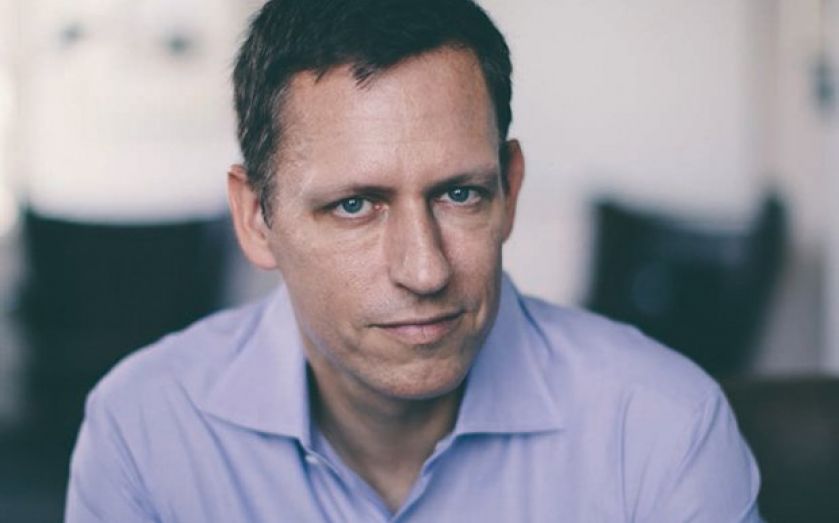
It's not every day that you get to speak to Silicon Valley royalty. And Peter Thiel, co-founder of PayPal, first outside investor in Facebook, fund manager, and leader of multiple firms, is a dynasty heavyweight.
Having just published his new book, Zero to One, he’s keen to talk about some of his latest ideas. A line those familiar with Thiel will recognise comes up quickly: “I think luck is just an atheistic word for God.” The message is obviously an important one – he devotes a whole chapter in the book to the subject: You are not a Lottery Ticket. For Thiel, whose net worth is estimated to be $2.2bn (£1.4bn), skill and merit get you places – not sitting back and leaving it to chance. “It’s a bad way to think. When we ascribe luck to things, it’s not a metaphysical truth about the world, but often just a sign of our laziness.”
Thiel concedes that there were aspects of his own life which, at the very least, put him in a fortunate position. He answers immediately when we ask who his greatest role models were growing up: “my parents”. But convention never felt quite right to him. “I was tracked in the elite university system. That was good in some ways, but it also meant I didn’t think very much about the future. I didn’t need to think about the future.” The blur of an undergraduate degree (at Stanford), law school and the (arguably inevitable) move to a big law firm in New York left him feeling unsatisfied. “On the outside, everybody wanted to get in. On the inside, everybody wanted to leave. And so I had this quarter-life crisis in my twenties where I realised that the sort of default, of doing what conventionally made sense, had brought me to a relatively unhappy place.”
CASTLE-BUILDER
Being a long-term thinker is something Thiel practises and preaches. “I do think it’s incumbent on all of us to think really hard about what we want to do with our lives.” And for those that decide to build a startup, he’s clear about the individual benefits, as well as the impact you’ll have more widely: “you can have agency not just over your own life, but over a small and important part of the world. It begins by rejecting the unjust tyranny of chance,” he says in Zero to One.
Thiel’s frustration with humanity, really, is that people just don’t think big enough. “They get too focused on their iPhones and all the other products to see the lack of any revolutionary age. If you want to become the next Apple, don’t set up a restaurant.” This attitude comes across in where he puts his money. His Founders Fund invested in Elon Musk’s SpaceX, along with British artificial intelligence firm Deep Mind Technologies, which was bought by Google at the beginning of 2014 for £240m. More recent investments through the Thiel Foundation – which possibly demonstrate what is closest to Thiel’s heart – include support for anti-aging research via the SENS Foundation, funding for Modern Meadow, a biotech company that produces cultured meat and leather products with no animal slaughter, and the Seasteading Institute, which plans to establish autonomous ocean communities (pictured). And it’s unlikely the indefatigable billionaire will slow down – or believe anyone else should. “We’ve made tremendous progress, but there’s tremendously more that can be done.” That, as a society, we’ve made “almost no progress” in the war against Alzheimer’s and dementia concerns him: “It’s shocking that this hasn’t caused greater outrage, and that we’re not trying to do more.”
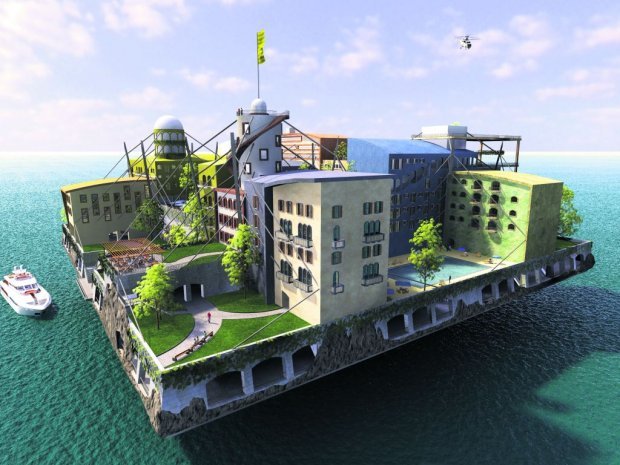
One of the designs for Seasteads – the world's first floating cities – in which Thiel has invested
TOPPLING LEVIATHAN
Thiel’s belief in the small, innovative game-changers is paired with a profound doubt over the ability of larger institutions to deliver the same: “the issue I’m always most concerned about is whether we’re going to have enough technological and scientific progress in the decades ahead. I worry that large institutions are not really able to push it in different ways.” In the US, he says, it’s now “inconceivable” that the government could deliver something like the Manhattan Project or Apollo programme again. We’ll see an increasing tip towards smaller businesses, he says – “progress will happen there.”
Thiel’s vocal concern over stale institutions undergoing a “sort of shocking decline” isn’t surprising. A long-time libertarian and supporter of the US Libertarian Party, his criticism of the state and state privilege has, over the years, been wide-ranging. He has, however, been mellowed by age (he’s now 47) – more interested in usurping, rather than conquering. “As an undergraduate and into my twenties, I’d have all these late-night political discussions… I’d love to tackle [the state] head on – we could have a society that’s vastly better in all these different ways. But it’s people building these new technology companies that has changed the world more – rather than political debates.”
SHIFTING UP A GEAR
And you’d be hard-pressed to find someone better placed to talk about these revolutionary firms – and where they’re heading. Apple’s Steve Jobs is lauded by Thiel several times in Zero to One. “Jobs saw that you can change the world through careful planning.” But the vision of number one meant that number two – Tim Cook – “has almost impossible shoes to fill”. Thiel is optimistic about the improvements Apple will continue to make on existing products, but not so hot on Apple Pay. He says that most people won’t gain a huge benefit from it compared to the payment methods they already use.
He has invested in Lyft, the peer-to-peer ridesharing company. He’s upbeat about the sector, and the sharing economy more widely, although he has less excitement for Uber than many investors. Some, he says, overestimate the value of services they or those they know use, and underestimate the value of those they don’t. But exemplar of the evolving industry, Airbnb, gets a bullish thumbs up – it could, he says, “be an $100bn company”.
Thiel’s positivity comes through even in areas he’s sceptical about. He’s known for being a critic of higher education, believing it to be “an enormous bubble,” with a trillion dollars of student debt equalling “a trillion dollars worth of lies about the value of education.” But he readily admits that thinking of a viable alternative is hard. Of course, he’s come up with his own response: annually, the Thiel Fellowship gives 20 promising young people $100,000, spread over two years, to allow them to shelve their education and focus on setting up a business. The move has proved controversial, but Thiel’s sticking to his guns: “It’s not what people want to hear. The rather disturbing message that I have is rather like that of a sixteenth century religious reformer: you need to think really hard about what you’re doing. You can’t just count on the system to save you.”