How the modern world is changing grave stone design forever


Death is the only thing surer than taxes. But how we’re remembered is a strange and sometimes controversial business. Ralph Jones meets the people rewriting the rules, one grave stone at a time
Stonemason Neil Luxton once agreed to use comic sans on a grave. Once was enough – he has refused ever since. Luxton, however, is no stuffy traditionalist: indeed he is one of a growing number of designers who believe most modern graves are actually quite boring and don’t do justice to the dead.
He is dedicated to quietly tearing up the gravestone rulebook, turning the often drab and predictable slabs into something personal and inspiring. “I try to encourage something unusual,” he says. His goal: to elevate the hunks of rock that will be our final legacy into “a statement of a person’s life”.
If you’re the kind of person taken to skulking around graveyards, you’ll have noticed the odd stone that stands out among the sea of rectangles and crosses. In Highgate – the most famous of London’s Magnificent Seven cemeteries – you can find painter Patrick Caulfield’s ‘DEAD’ memorial, a grand piano tomb in honour of the concert pianist Harry Thornton, and writer Douglas Adams’ neat rectangle, complete with pen holder. Over in Paris’s Montparnasse there’s geographer Antoine Haumont’s symbolist sculpture of two people reading and the light, modern grave of Jean-Paul Sartre and Simone De Beauvoir, which is forever covered in red lipstick kisses.
A century ago, such frivolity would have seemed absurd. Slowly but surely, however, graves have evolved with the times. The memorialisation of the dead isn’t a business in which anything happens quickly but the ground is always shifting, so to speak.
In the 1970s, there was far less variety, with most memorials containing some religious iconography. This dropped off alongside religiousness as a whole. When it comes to typefaces, Times New Roman is “extremely popular”, says Luxton. While this may seem a little anachronistic in our age of clean, sans serif fonts – those without the little flourishes at the top and bottom of letters – it actually represents progress: before the 1990s, people wanted Gothic-style lettering, which has now fallen out of fashion.
The style of lettering has also changed. “One of the things that has become fashionable is the extensive use of upper and lower case on a memorial,” says Luxton. In the Victorian era, all of the letters used to be titlecase. “There are a lot more rounded letters today.” This change is the result of modern technology: it was traditionally harder to carve lower-case letters by hand but a computer makes no such distinction.
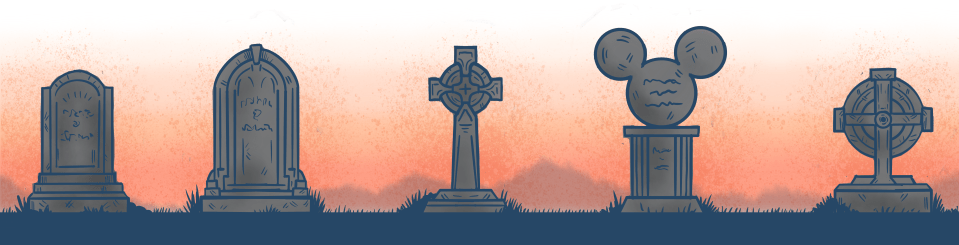
Occasionally people will request a beloved cultural figure like Mickey Mouse to look over them as they rest in perpetuity. “But Disney’s difficult,” grumbles Luxton. “They may say, ‘You can have a Mickey Mouse or Donald Duck but you can’t have the one you sent us.’” Regulations on a gravestone’s appearance differ from cemetery to cemetery but a three-foot height limitation is fairly common.
At Highgate, a bare minimum of information a gravestone should give is the occupant’s full name and birth and death dates. Peter Humphries, head of planning and projects at Kensal Green Cemetery, says, “Unless it were to be carved in what might be construed in an offensive way, there’s very little restriction on what it might look like in the end.”
Luxton is not alone in his quest to take that as a challenge. “One of my goals is to shake the industry up,” says Mark Brooks, a stonemason who also works on memorials for Highgate. “It’s depressing walking around many cemeteries, because you just get this sea of black shiny granite with gold letters, Times New Roman; no thought whatsoever [has gone in] to the design or lettering.”
Black granite, it turns out, is a controversial trend. Banned as a material in Highgate since around 2000, it has become popular virtually everywhere else because of its affordability. Imported from China or India, it has become the default stone of the British graveyard. Because it is comparatively brittle, however, it is harder to hand-carve letters onto. Instead, inscriptions tend to be sandblasted – a relatively unskilled process that began to replace hand-carving in the 1990s, involving firing sand at high velocity. Fewer and fewer British stones are used and local stonemasons have “effectively disappeared”, says Brooks.
This sits predictably badly with Mark Noad, chair of trustees of the Lettering Arts Trust, an organisation that champions and trains letter carvers. Because polished black granite isn’t a native British stone, Noad says it doesn’t fit with the British landscape. It doesn’t age much either, unlike the classic weathered gravestone that probably exists in your mind’s eye.
The Trust commissions bespoke memorials using hand-drawn lettering instead of a typeface. There is a glimmer of hope that this kind of work might be on the up: the Heritage Craft Association used to list letter carving as an endangered craft but, as of a few years ago, no longer do.
Over time, the possibilities within memorialisation have enabled more expression. “Headstones have become more elaborate,” says Joe Batt, head of retail at stonemasons R Munday and Son, who points to a popular design of theirs that includes three hearts with carved roses between them.
This complexity is almost entirely down to the new technology that has transformed the industry. Brooks used to make four or five memorials a year by hand; now he makes around 500, thanks in part to his ability to let a computer operate his tools. It is now possible to etch almost anything onto a gravestone using lasers. Computers also allow customers to see exactly what they’re getting, giving them more control. Today requests include football badges; photographs; and several times Luxton has carved a replica of a Fender guitar onto a gravestone.
Another of Luxton’s unusual commissions was for the late public intellectual Jonathan Miller, who found fame in the comedy show Beyond the Fringe, went on to direct operas, and died in 2019. Miller’s son William says, “My father was always rather disparaging of any kind of burial or monument to him, and sort of said, ‘Just shove me in a skip.’ We obviously chose not to do that.”
Miller had always been obsessed with a plaster-cast ‘life mask’ made of him when he was in his forties. Using this as a memorial seemed appropriate, thought William. The opera designer Isabella Bywater made a negative version of the face in bronze, and Luxton’s job was then to embed the mask – about four inches deep – into a gravestone. When I visited Highgate Cemetery recently, I saw the optical illusion effect of the mask up close. The four-foot grave, which went up in October 2024, is about 50 yards from Karl Marx. “I can’t say, ‘He’s up there somewhere looking down on us and he’d be dead pleased’,” says William, “but I do feel a duty to honour him in a way that he would find fitting – and that would amuse him.”
Part of the reason graves became so homogenous in the first place was the fact that people don’t tend to pick them themselves. Have you thought about how you want to be commemorated when you die? The answer is almost certainly: “no”, according to Julie Dunk, chief executive of the Institute of Cemetery and Crematorium Management. “We do not speak enough about death and what’s going to happen to us,” she says. More often than not, relatives are left to guess at what their loved one might have wanted.
This is changing. In our hyper-individualistic age, people want to stand out from the crowd and are more willing to think about their enduring physical legacy. “People want to be individual,” says Dunk. “There was a period when we didn’t; they wanted to conform and have a regulation headstone because that was the fashion at the time.” As evidence of this shifting attitude, she recalls one headstone made from pieces of laminated glass, and another in the shape of a dolphin.
Noad remembers being moved by one grave in the shape of a football shirt. Another gravestone enthusiast, Ian Dungavell, chief executive of the Friends of Highgate Cemetery Trust, is particularly fond of a memorial whose corner had been deliberately exposed, revealing what looked like Lego blocks inside. Such designs may be prohibitively expensive but Dungavell says that even if you are restricted by budget, you can always personalise the words on a gravestone. “If someone recommends a piece of text that you’ve never read before in your life, just don’t use it.”
Personally, I love the idea of brightening someone’s day as they’re walking through a graveyard. These public monuments are how we will be remembered by family and strangers alike.
It’s important to give the whole thing some thought – especially as it’ll be too late to complain once you’re buried beneath it. As Brooks puts it, “It’s permanent – there’s no backspace when you’re carving a stone.”