Thames Tideway: Just how super is London’s new super sewer?

“A national scandal,” Sadiq Khan said of the amount of sewage pumped into the River Thames last year.
But it took more than the Mayor of London to spur national revulsion at the state of England’s longest river.
Fast forward a few months and the spotlight had fallen on the 2024 Oxford-Cambridge boat race in April, as a bout of E Coli swept through a number of the competing rowers.
Amid widespread outrage, the blame was pinned on the UK’s biggest water supplier, Thames Water, which is in the midst of a financial crisis and narrowly avoided bankruptcy earlier this year.
Throwing more sh*t at the beleagured utility seems both justified and inevitable at this point. But if there is any redemption for Thames it is that it can lay claim to helping devise a potential solution to London’s own sh*t problem.
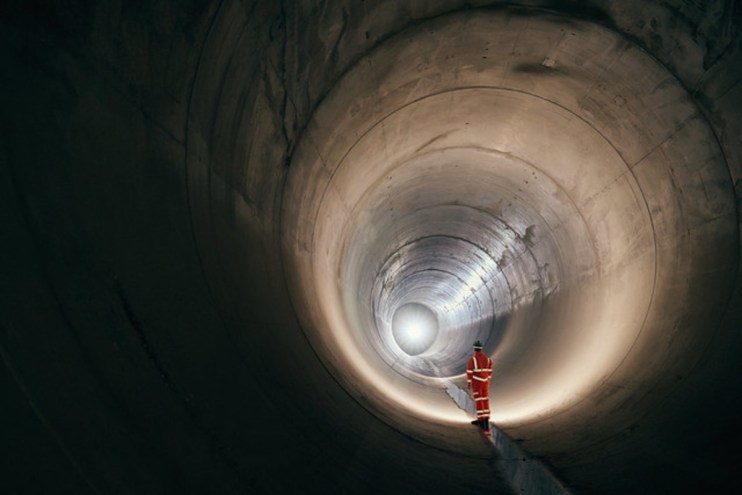
The roughly £4.5bn, 25km Thames Tideway Tunnel, dubbed the “Super Sewer,” was opened by King Charles III last week after more than 10-years of work.
The project is the largest upgrade to London’s sewers since their construction by John Bazalgette following the “Great Stink” of 1858.
Its aim? “To reconnect Londoners to the River Thames,” says the project’s chief technical officer, Roger Bailey. “To clean up the river and have it so people are going down and engaging with it… Just having more river-related activity.”
It is a vision shared by Sadiq Khan, who recently unveiled plans to “make rivers in London swimmable within 10 years”.
And so far, London’s super sewer seems to be working. Publicly available data shows around 6.8m cubic metres of sewage has been diverted from the River Thames since its launch – the equivalent of almost 2800 Olympic-sized swimming pools.
For Bailey, a veteran civil engineer with more than three decades experience, the core value of the project is unquestionable.
While London’s Victorian-era sewers were an engineering marvel, they simply did not have the capacity to handle more severe weather.
Just 2mm of rainfall could cause overflows in certain areas of the capital, according to some estimates. The super sewer will suck out sewage from 34 of the most polluting combined overflows (CSOs) along the river.
“You can’t argue about the benefits of a project like that. Some projects come up, they are a bit controversial,” he tells CityAM.
“As of now, 95 per cent of sewage that would have gone in the river in a storm is going into our tunnel. We are even starting to get anecdotal evidence from river users… so that’s fantastic.”
Tideway’s underlying mission is undoubtedly a noble one – but Bailey concedes it hasn’t entirely escaped controversy.
Who is on the hook for super sewer?
The big question is whether the scheme, which has been – and will continue to be – funded via a hefty hike to Thames Water’s billpayers, is value for money.
Concerns were raised from the outset that the River Thames would be better served with a more modest urban drainage solution, or by upgrading the existing infrastructure.
The cost of delivering such a colossal project has been justified by Tideway’s avant garde private financing model, which is lauded by industry and even mooted by Rachel Reeves as a possible option for the £9bn Lower Thames Crossing.
Tideway was able to lure in private investors including Allianz and the investment firm’s Dalmore Capital and Amber Infrastructure, after ministers agreed to offer guarantees against any cost overruns.
Considering the likes of HS2 and the Lower Thames Crossing, the cost increases at Tideway seem acceptable. But they have still risen from an initial estimate of £1.7bn in 2005 prices to more than £4bn.
Chris Morgan, senior investment director at Amber Infrastructure, told CityAM the backstop from government enabled the private sector to price the asset “much more keenly”.
“If costs hit a certain point government would step in and fund the excess and that meant as a private sector consortium you can… price it more tightly, offering better value for money for consumers,” he said, adding that no extra money from government had yet been required.
But Thames Water’s customers will still have to pay off a big loan from shareholders. Tideway’s backers put in around £1.3bn at the start of the project, structured as £550m in equity and £750m in the form of a fixed loan.
That loan has drifted up to more than £900m as of 2024 at an interest rate of eight per cent, to be paid by customers over 40 years. It’s also compounded, meaning annual payments could reach as high as £100m in interest on the loan alone.
“It’s an outrageously high level of interest,” argued David Hall, a visiting professor at the University of Greenwich and long-running critic of the project’s finances.
“At the time the loan was put out, the general level was around four per cent. It was a grotesque example of the worst practice of shareholder loans.”
He added: “It’s an obviously exploitative practice because there’s no internal protection against the interest rates being charged… It has been done by the water companies in various ways in the past.”
It comes as Thames Water’s 16m customers already face massive bill hikes over the next decade, as the debt-laden utility attempts to avert financial catastrophe.
Tideway refutes that the loan will be compounded over the next four decades, with the current plan for it to be “converted to equity” in 2027 when the project’s contracts are fulfilled, according to a spokesperson.
It said the loan’s structure was “designed to ensure a return to shareholders” through construction, keeping capital costs down and thus taking the weight of customer bills.
“At the start of the project, the cost estimate to billpayers was set at £20 to £25 in 2014/15 prices. The cost remains within that range,” with the most recent year being £17 in equivalent prices, the spokesperson added.
Outcomes
Debates over Tideway’s financial model are all the more pertinent as Rachel Reeves puts infrastructure at the heart of economic growth plans and Thames Water’s struggles capture the nation’s fury.
Regardless, the project remains an engineering marvel. So how was it possible to tunnel through the centre of London? Not easily, is the simple answer.
Hurdles for any scheme of national significance are always vast, from lengthy planning procedures to the technicalities of construction.
Speaking from near the Tideway’s Blackfriars site, Bailey recalls everything from planning delays to health and safety, to handling the capital’s creaking Victorian infrastructure during construction.
“We had to get right up close to the old Victorian river walls, we had to break into culverts that were built by Sir Joseph Bazalgette over 150 years ago,” he explained.
The difficulties were compounded by concerns over traffic and disruption to local communities, which restricted the investigations that could take place ahead of delivery.
In one instance, the “whole construction methodology” for the Blackfriars segment had to be changed at the height of the Covid-19 pandemic.
“I think Blackfriars was a massive success,” Bailey said. “It added some money to our project but the way we handled that and the way we worked with our contractors was very collaborative.”
The result of such struggles will ultimately be a cleaner River Thames. It comes back to Bailey’s first remarks – that the aim of the Tideway Tunnel is something almost everyone can get behind.
But questions remain: is Thames Water really the right company to run it? Have billpayers been taken for a ride?
As is often the case with big infrastructure, outcomes seem to matter more than the journey itself.